Mac emoji keyboard: every way to open it, skin tones, Genmoji, and what to do when Fn-E does nothing

Also in日本語한국어繁體中文简体中文EspañolDeutschPortuguês (Brasil)Français
Quick answer
On a Mac, the emoji keyboard is the Character Viewer: click where you're typing, press Fn-E (Globe-E) or Control-Command-Space bar, then search for an emoji and click it. This guide lists every way to open it for each kind of keyboard on macOS 27, Tahoe, Sequoia and Sonoma, then covers skin tones, favorites, the menu bar, emoji text replacements, Genmoji and Memoji, and what to check when the shortcut does nothing.
Download for MacThe Mac emoji keyboard is a panel called the Character Viewer. Click where you're typing, press Fn-E (Globe-E on keyboards with the globe) or Control-Command-Space bar, type a word such as "heart" in its search field and click the emoji you want. Edit › Emoji & Symbols opens it too. To open it with one press, choose Show Emoji & Symbols for "Press Globe key to" in System Settings › Keyboard.
We read every Apple and Microsoft page linked here on 22 November 2026: Apple's Mac User Guide for macOS 27 Golden Gate (27.2.1 is the latest release Apple lists) and its Tahoe, Sequoia and Sonoma editions, Apple's Mac keyboard shortcuts article (dated September 14, 2026) and its Apple Intelligence pages. What Shimejiko does comes from the app's own code, version 1.4.0. For the rest of the Mac's keys, see Mac keyboard shortcuts by task.
Which keys open the emoji keyboard on a Mac?
That depends on two things: the key in the bottom-left corner of your keyboard and your macOS version. Apple calls that key Fn or Globe: newer Apple keyboards print a globe on it, others just read fn, and many keyboards not made by Apple have neither. We built this table by putting Apple's emoji page from each of the four Mac User Guide editions (macOS 27, Tahoe, Sequoia, Sonoma) next to the shortcut article, the Keyboard settings page and the Input menu entry. We didn't try every keyboard ourselves.
| Way to open it | Keyboard with the Globe key | Keyboard with an fn key | Keyboard with no Fn or Globe key | macOS |
|---|---|---|---|---|
| Fn-E or Globe-E | Globe-E | Fn-E | Not available | 27, 26, 15 and 14 |
| Control-Command-Space bar | Yes | Yes | Yes; on a keyboard made for Windows PCs, Ctrl-Windows logo key-Space bar | All four; Apple's list gives no version limit |
| The key pressed once | After setting "Press Globe key to" to Show Emoji & Symbols | After setting "Press fn key to" to Show Emoji & Symbols | Not available | All four |
| The key pressed twice (Fn-Fn in Apple's list) | Yes, unless the key is set to Start Dictation | The same | Not available | Apple's current list, no version given |
| Edit › Emoji & Symbols in the app's menus | Yes | Yes | Yes | All four |
| Input menu in the menu bar | Yes | Yes | Yes | All four, after you switch it on |
| Emoji button in Mail or Messages | Yes | Yes | Yes | Apple's tip appears on the 27, 26 and 15 pages, not Sonoma's |
Two routes work on any keyboard: Control-Command-Space bar needs no special key, and the Input menu needs no keys at all. Apple's Sonoma page writes the shortcut as "Fn-E or Globe-E", and later pages as "Fn/Globe-E": the same keys. On a Windows keyboard, Apple's shortcut article says to press Ctrl or the Windows logo key where a shortcut says Command, which is why the second row reads the way it does. And a MacBook Pro with a Touch Bar has one more route: in some apps, tap the Emoji button on the Touch Bar and swipe through the categories (Apple).
What changed between macOS 14, 15, 26 and 27?
The Character Viewer itself has hardly changed in four versions. What changed is around it:
| macOS 27 | 26 Tahoe | 15 Sequoia | 14 Sonoma | |
|---|---|---|---|---|
| Search, skin tones, favorites, sizes | Yes | Yes | Yes | Yes |
| The shortcut as Apple's emoji page writes it | Fn/Globe-E | Fn/Globe-E | Fn/Globe-E | Fn-E or Globe-E |
| Making Genmoji from the Character Viewer | Yes | Yes | From 15.3 | No |
| Genmoji Suggestions switch in Keyboard › Text Input › Edit | Yes | No | No | No |
| Show Input menu in menu bar, in the same place | Yes | Yes | Yes | Yes |
Apple's Sequoia update notes say macOS Sequoia 15.3 "introduces Genmoji", with Genmoji creation in Messages and other apps. The Genmoji Suggestions switch appears only in the macOS 27 edition of Apple's Input Sources settings page, which describes it as suggested Genmoji "from your photos and commonly typed phrases"; the Tahoe edition doesn't list it.
How do I turn a word into an emoji as I type?
This is the fastest route, because it skips the search (Apple):
- Type a common word or phrase, such as heart or thumbs up.
- Press Fn-E (Globe-E).
- Press Return to replace the word with the suggested emoji, or choose another suggestion. The Arrow button shows more of them in the Character Viewer.
If macOS has no suggestion for the word, the Character Viewer opens instead, ready for a search.
How do I search, pick a skin tone and keep favorites?
- Press Fn-E or Control-Command-Space bar, or choose Edit › Emoji & Symbols.
- Type in the search field. Apple's example is "laughing face".
- Click the emoji to put it in your text. In the expanded viewer, double-click it instead.
- For skin tones and other variations, click and hold the emoji.
The viewer comes in two sizes, a small panel and an expanded window with a sidebar; the Expand or Collapse button in its upper-right corner switches between them. Most of its settings need the expanded one:
- Favorites: select an emoji or symbol and click Add to Favorites. In the small panel, favorites sit at the top, below the emoji you used recently. In the expanded window, they get their own Favorites category in the sidebar.
- Which categories appear: click the Action pop-up menu, choose Customize List, then select the categories you want and click Done. Besides emoji, the viewer holds symbols, accented letters and characters from other languages.
- Bigger or smaller characters: in the same Action menu, choose Small, Medium or Large.
- A fresh start: Clear Frequently Used Characters, also in the Action menu, clears the emoji and symbols the viewer remembers you using.
Sonoma's page words the favorites step a little differently but describes the same result. For more small time-savers like these, see our MacBook tips and tricks.
How do I make one press of the Globe key open emoji?
- Choose Apple menu › System Settings, then click Keyboard in the sidebar (you may need to scroll down).
- Click the "Press Globe key to" pop-up menu. On keyboards without the globe it reads "Press fn key to".
- Choose Show Emoji & Symbols.
The other three choices explain a key that seems to misbehave (Apple). Change Input Source switches between keyboard layouts, Start Dictation starts listening when you press the key twice, and Do Nothing means the key does nothing alone. The setting has the same four choices on Tahoe, Sequoia and Sonoma.
How do I open emoji from the menu bar?
With the Input menu, which sits near the right end of the menu bar (Apple):
- Choose Apple menu › System Settings, then click Keyboard.
- Under Text Input, click Edit.
- Turn on Show Input menu in menu bar.
If you type with one keyboard layout, the menu shows the Character Viewer icon; with two or more, it shows the current layout's letters, and macOS turns it on by itself. Click it to open emoji and symbols from any app, which is handy when an app has taken over the shortcut. The same menu also has Show Keyboard Viewer, which is a different tool: an onscreen keyboard that shows your layout and the keys for accents, not emoji (Apple).
How do I type emoji with a text shortcut?
Text replacements turn a few letters into an emoji in the apps that support them. Apple's own example replaces XD with 😆 (Apple):
- Choose Apple menu › System Settings, click Keyboard, then click Text Replacements. Inside an app, Edit › Substitutions › Show Substitutions, then Text Settings, opens the same place.
- Click the Add button. In the first field, type the shortcut, for example :thumb. In the second, put the emoji, picked from the Character Viewer.
- Click Add, then Done.
If typing the shortcut does nothing in one app, open Edit › Substitutions there and check that Text Replacement has a checkmark. Apple notes that text replacements aren't available in all apps, and that with Chinese or Japanese input sources they're kept in your user dictionary instead.
Which Macs can make Genmoji?
Genmoji are emoji you create with Apple Intelligence from a description, existing emoji, a person or a photo. Here is exactly what Apple lists for macOS 27, from How to get Apple Intelligence (published November 5, 2026) and the macOS 27 Genmoji guide:
- Macs: MacBook Neo (A18 Pro) and any Mac with M1 or later. Sequoia's guide named Mac models with M1 or later.
- Languages: Siri and the device set to the same supported language: Chinese (Simplified), Chinese (Traditional), Danish, Dutch, English, French, German, Italian, Japanese, Korean, Norwegian, Portuguese, Spanish, Swedish, Turkish or Vietnamese. Sequoia's list was shorter: English (Australia, Canada, India, Ireland, New Zealand, Singapore, South Africa, UK or U.S.), Chinese (Simplified), French, German, Italian, Japanese, Korean, Portuguese (Brazil) and Spanish.
- Regions: Apple says many features are available "in most regions around the world", with separate notes for the EU and China mainland. Apple Intelligence doesn't currently work on devices bought in China mainland, or on other devices while you're in China mainland with an Apple Account country or region there. Apple adds that some features may not be available in all regions or languages.
- Storage and limits: up to 8 GB of storage, or up to 14 GB on Macs with M3 or later and at least 12 GB of unified memory. The Genmoji guide notes that usage limits may apply.
- Families: Screen Time can block image creation features such as Genmoji.
On macOS 27, Apple says Apple Intelligence is available automatically on eligible Macs in supported languages and regions. The Tahoe and Sequoia guides tell you to use the latest version of macOS and make sure Apple Intelligence is turned on.
How do I make and delete a Genmoji?
On macOS 27, per Apple's guide:
- While writing in an app, press Fn-E (Globe-E). In Mail or Messages, you can click the Emoji button instead.
- Click the Genmoji button at the top right of the Character Viewer.
- Enter a description, click the Emoji button to start from an emoji or Genmoji, click Choose Person to add up to three people from your Photos library, or click Choose or Take Photo for something else, like a pet, nature or food.
- Refine it by describing a change or combining it with other emoji; scroll up or down to move between versions.
- Click Add.
New Genmoji are saved with your stickers in the Character Viewer. To delete one, press Fn-E, click the Stickers button, Control-click the Genmoji and choose Delete. The steps differ on older versions: Tahoe's guide lets you mix up to seven elements, including concepts such as costumes, accessories and places, and Sequoia's starts from a field called Describe an Emoji.
How do I send Memoji stickers from a Mac?
Memoji live in Messages (Apple):
- Open a conversation in Messages.
- Click the Apps button to the left of the message field, choose Stickers, then select the Memoji button.
- For your first Memoji, click the Add button; for another, click the More button and choose New Memoji. Design it with the categories from Skin to Body, click Done, then scroll to choose a pose.
- Select a Memoji sticker. To add words, type them in the field and press Return. You can also drag a sticker on top of a message in the conversation.
Any emoji, sticker or Memoji can also be a Tapback: Control-click a message and click the Emoji button for the full choice. Apple notes that sending stickers isn't available in all countries or regions.
Why does the emoji shortcut do nothing?
Go down this list:
- Fn-E does nothing: the shortcut needs Apple's Fn or Globe key. On any other keyboard, press Control-Command-Space bar.
- The Globe key alone switches language or starts dictation: that's the "Press Globe key to" setting. Choose Show Emoji & Symbols, as above.
- Your keyboard layout changed: without Command, Control-Space bar selects the last input source you used (Apple). Add Command.
- A word opened the full viewer instead of a suggestion: Apple says that happens when the word has no emoji suggestion. Search in the viewer instead.
- It works in every app but one: Apple says some shortcuts may be unavailable in some apps, so update the app first (Apple), and a shortcut can do something else in a particular app (Apple). In that app, use Edit › Emoji & Symbols or the Input menu.
- You want keys of your own: in Keyboard › Keyboard Shortcuts › App Shortcuts, click the Add button, choose All Applications, type Edit->Emoji & Symbols as the menu title and press your keys, following Apple's syntax. Apple warns that keys another command already uses won't work. We haven't tested this one, so check that your keys appear beside Emoji & Symbols in the Edit menu.
If you changed any system shortcuts earlier, look in Keyboard Shortcuts for a warning icon: Apple says it means another app already uses those keys.
What is the emoji shortcut on Windows?
Windows key + period (.) or Windows key + semicolon (;) opens the emoji panel on Windows 11 and Windows 10 (Microsoft). Microsoft's keyboard tips add that you keep typing to search, and that on Windows 11 the same panel has GIFs, kaomoji and symbols. For switchers:
| Job | Windows 11 | Mac |
|---|---|---|
| Open the emoji picker | Windows key + period | Fn-E, Globe-E or Control-Command-Space bar |
| Search | Keep typing once the panel is open | Type in the viewer's search field |
| Symbols | Symbols in the emoji panel | The same Character Viewer, with more categories in the expanded view |
| Emoji from a Windows keyboard plugged into a Mac | Not applicable | Ctrl-Windows logo key-Space bar |
Where does Shimejiko fit?
We make Shimejiko, a desktop pet app for Mac, and it adds nothing to the emoji keyboard. Its small characters walk along the Dock, climb your windows and sit on them, and they have little pictures of their own. The hearts on this page's cover are one: rest the pointer on a character and stroke the trackpad with two fingers, and it purrs while pink hearts float up. On a Force Touch trackpad you also feel the purr under your fingers; other trackpads get the sound and the hearts. The app treats that stroke as petting, never as a scroll for the window underneath, and Settings › Mac magic › Purr switches it off. Plug in a MacBook's charger and dinner is served, with a rice ball 🍙 above each character.
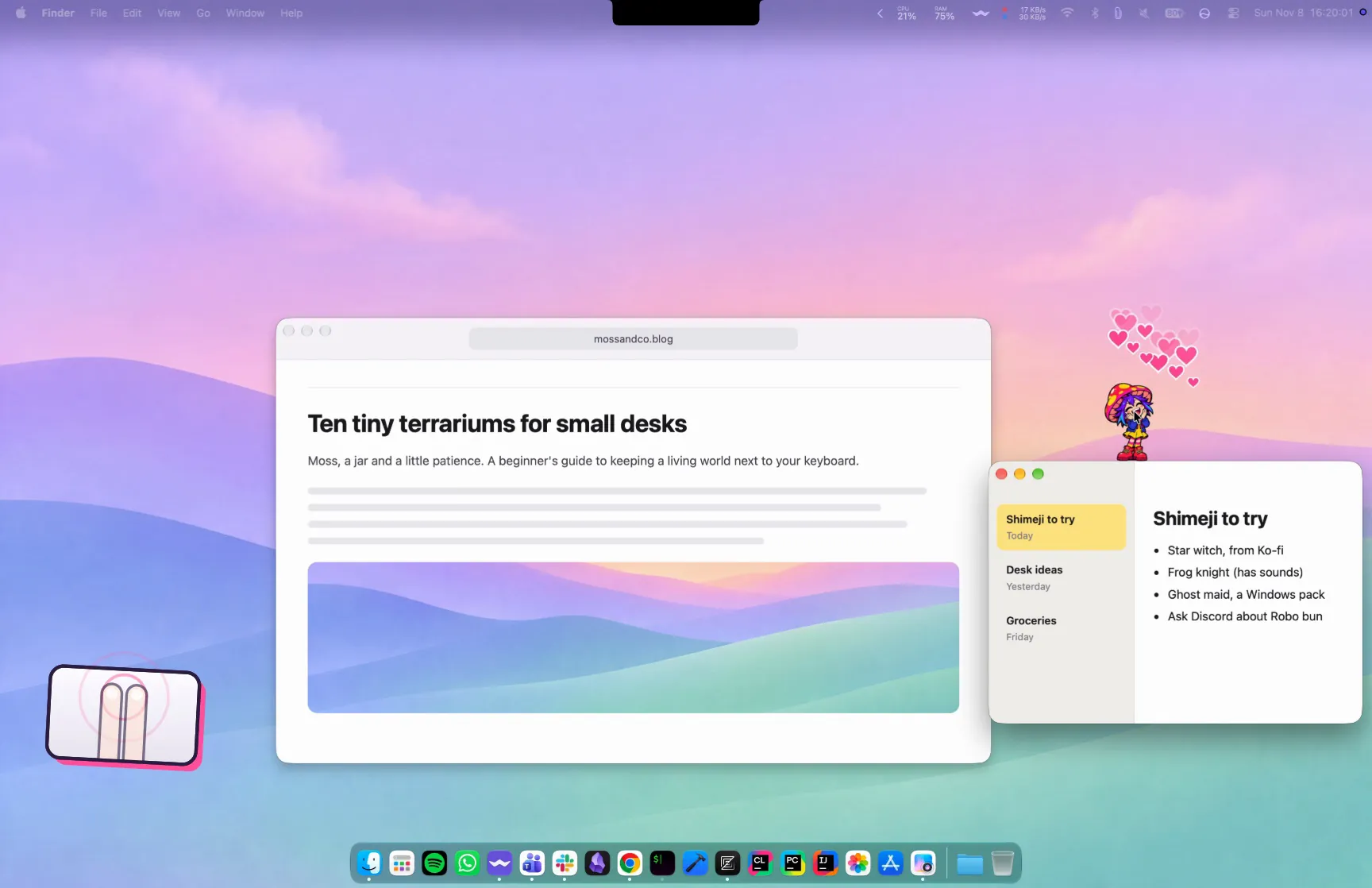
In the clip, Shimejiko stands on top of a Notes window, the pointer rests on her cap while two fingers stroke the trackpad (drawn in the corner), and pink hearts float up as she purrs.
Your keyboard gets one more reaction. With Accessibility access, fast typing streaks make up to three characters cheer with confetti, and now and then one says in a speech bubble that you're on a roll. The app counts key presses and never reads them, so it never sees which emoji you type, and the Typing card on the Mac magic screen turns the cheer off. Its one shortcut, Option-Command-H (⌥⌘H), hides every character and doesn't touch Fn-E or Control-Command-Space bar; Settings › General › Hide everyone changes it.
The catch: on the free plan, knock, lid and purr work on Shimejiko herself, and Pro brings them to every friend. Shimejiko is a free download for macOS 14 Sonoma or later on Apple silicon and Intel, and Pro is $5.99 once for up to 3 Macs (checked 22 November 2026). Get Shimejiko, see what the characters do on a MacBook, or set up a quieter crew with a desktop pet while working. For the rest of your desktop, start with 10 ways to customize your MacBook.
Questions
How do I add emojis to my keyboard on a Mac?
There's nothing to install: every Mac has the Character Viewer. Press Fn-E or Control-Command-Space bar, or turn on Show Input menu in menu bar to keep it a click away. To make the Globe key itself your emoji key, set "Press Globe key to" to Show Emoji & Symbols.
How do I get emojis on a laptop?
On a MacBook, click in a text field and press Fn-E (Globe-E). On a Windows laptop, press Windows key + period.
How do I insert a 👍 emoji?
Type thumbs up, press Fn-E, then press Return to take the suggested emoji. Or search "thumbs" in the Character Viewer, and click and hold the result for other skin tones.
How do I edit an emoji?
You can't redraw Apple's emoji, but you can pick a different skin tone by clicking and holding one in the Character Viewer. For something new, make a Genmoji and describe changes until you like it, before you click Add. To put an emoji on a folder rather than in text, see Mac folder icons.