Mac keyboard shortcuts by task: windows, text, screenshots and Finder, and how to change or undo them

Also in日本語한국어繁體中文简体中文EspañolDeutschPortuguês (Brasil)Français
Quick answer
The Mac keyboard shortcuts worth learning, grouped by the job they do: switching apps and tiling windows, editing text, screenshots, Finder, Spotlight, the Globe key and accessibility. Every key comes from Apple's own pages for macOS 27 Golden Gate, with a table of what differs on Tahoe, Sequoia and Sonoma, a Windows-to-Mac table, the steps to make your own shortcut in System Settings, and where to put each change back.
Download for MacThe Mac keyboard shortcuts to learn first swap Windows' Ctrl for Command: Command-C, Command-V and Command-Z copy, paste and undo, Command-Tab switches apps, Command-Space bar opens Spotlight, Command-Q quits and Option-Command-Esc force quits. Shift-Command-4 captures part of the screen, and on macOS 15 or later Fn-Control-Left Arrow tiles a window. Every app lists its shortcuts beside its menu commands, and System Settings › Keyboard › Keyboard Shortcuts changes them or restores the defaults.
We checked every page linked here on 21 November 2026. The macOS keys and setting names are Apple's, from its Mac keyboard shortcuts article (dated September 14, 2026) and the Mac User Guide for macOS 27 Golden Gate, the current version. Where Tahoe, Sequoia or Sonoma differ, we say so.
Which keys do Mac shortcuts use?
Hold the modifier keys, press the last key, then release them all. Menus print the modifiers as symbols (Apple):
| Symbol | Key |
|---|---|
| ⌘ | Command |
| ⌥ | Option |
| ⌃ | Control |
| ⇧ | Shift |
On newer Apple keyboards the Fn key also carries a globe, so Apple calls it Fn or Globe. On a PC keyboard, Apple says Alt stands in for Option, and Ctrl or the Windows logo key for Command. Hold Fn to make the top row's brightness and volume keys act as F1, F2 and so on, or turn on "Use F1, F2, etc. keys as standard function keys" in System Settings › Keyboard › Keyboard Shortcuts › Function Keys (Apple).
Which shortcuts should you learn first?
| Job | Shortcut |
|---|---|
| Copy, cut, paste | Command-C, Command-X, Command-V |
| Undo, redo | Command-Z, Shift-Command-Z |
| Find in a document | Command-F |
| Save, print | Command-S, Command-P |
| Close the window, quit the app | Command-W, Command-Q |
| Force quit a frozen app | Option-Command-Esc |
| Switch apps | Command-Tab |
| Search the Mac and the web | Command-Space bar |
| The front app's settings | Command-Comma (,) |
| Lock the screen | Control-Command-Q |
Command-W closes a window but leaves its app running; Command-Q ends the app. Add Option and many shortcuts reach the whole app: Option-Command-W closes all its windows, and Option-Command-M sends them all to the Dock.
How do you switch apps and arrange windows?
Hold Command and tap Tab to step through open apps, adding Shift to go back. Command-Grave accent (`), usually the key above Tab, moves between windows of the app in front. Command-H hides that app, and Option-Command-H hides every other one. Control-Up Arrow opens Mission Control, Control-Down Arrow lays out the front app's windows, Fn-H clears the screen to show the desktop, and Control-Command-F switches an app in and out of full screen, if the app supports it.
Window tiling keys arrived with macOS 15 Sequoia, and Apple's tiling table is identical for Sequoia, Tahoe and macOS 27 (Sequoia's copy):
| Keys | What the active window does |
|---|---|
| Fn-Control-Left or Right Arrow | Takes the left or right half |
| Fn-Control-Up or Down Arrow | Takes the top or bottom half |
| Fn-Control-F | Fills the desktop, without going full screen |
| Fn-Control-C | Moves to the center |
| Fn-Control-R | Returns to its size before tiling |
| Fn-Control-Shift plus an arrow | Takes that half; the next window gets the other half |
| Fn-Control-Option-Shift plus an arrow | Takes that half; the next two windows split the other half |
Apple gives the four corners and Quarters no keys; they sit under Window › Move & Resize, and you can add keys yourself, as shown further down. If tiling gets in the way when you drag windows, System Settings › Desktop & Dock › Windows has switches such as "Drag windows to left or right edge of screen to tile" and "Tiled windows have margins" (Apple). For Split View, Stage Manager and the names on each macOS version, see split screen on Mac.
Which shortcuts make text editing faster?
| Keys | What they do |
|---|---|
| Option-Left or Right Arrow | Jump one word back or forward |
| Command-Left or Right Arrow | Jump to the start or end of the line |
| Command-Up or Down Arrow | Jump to the start or end of the document |
| Shift added to any of those | Select the text instead of jumping |
| Option-Delete | Delete the word to the left |
| Fn-Delete | Delete the character to the right |
| Option-Shift-Command-V | Paste and Match Style, which drops the copied formatting |
| Control-Command-D | Show the definition of the selected word |
| Control-Command-Space bar or Fn-E | Emoji and symbols |
They can vary from app to app, Apple warns. One oddity: Control-K cuts to the end of the paragraph onto a separate clipboard that only Control-Y in the same app pastes, leaving your Command-C clipboard alone.
How do you take screenshots and screen recordings?
| Keys | What you get |
|---|---|
| Shift-Command-3 | The entire screen |
| Shift-Command-4 | An area you drag across; hold Space bar to move it, press Esc to cancel |
| Shift-Command-4, then Space bar | One window or menu; Option-click leaves out its shadow |
| Shift-Command-5 | The Screenshot app, for recordings and options |
Press Control along with any of them, for example Control-Shift-Command-3, and the picture goes to the clipboard rather than to a file on the desktop. The Screenshot app's Options menu sets a timer, the save location, the floating thumbnail and whether the pointer appears. On macOS 26 Tahoe and later, supported Macs can also pick SDR (PNG) or HDR (HEIF) there (Apple).
macOS 27 adds two keys for Siri AI (Beta): Shift-Command-6 selects part of the screen and Shift-Command-Space bar a window, so you can ask Siri about it. Siri AI needs a Mac with M1 or later or the MacBook Neo and, for now, English, French, Japanese, Korean, Portuguese or Spanish (Apple).
Which Finder shortcuts save the most clicks?
| Keys | What they do |
|---|---|
| Shift-Command-G | Go to Folder, where you type a path |
| Shift-Command-H, Shift-Command-D, Shift-Command-O | Open Home, Desktop or Documents |
| Option-Command-L | Open Downloads |
| Command-1 to Command-4 | Icon, list, column or gallery view |
| Command-Up Arrow | Open the folder one level up |
| Command-Down Arrow | Open the selected item |
| Shift-Command-N | New folder |
| Command-Delete | Move the selection to the Trash |
Return renames the selected item (Apple), and the Go menu lists keys for the other common folders.
What do Spotlight and the Globe key open?
Command-Space bar opens Spotlight from any app. On Tahoe and macOS 27, Command-1 to Command-4 narrow it to applications, files, actions or your clipboard history (Apple); Sequoia's list has none of them. Type an app's name and press Tab to search inside it, or press Command-R to show a result in the Finder. The first time you open the clipboard, macOS may ask you to allow it, and Clear History sits under the More button (Apple).
The Fn or Globe key has its own set (Apple):
- Fn-A shows or hides the Dock.
- Fn-C opens Control Center, and Fn-N opens Notification Center with its widgets.
- Fn-Q starts a Quick Note, and Fn-D starts or stops dictation.
- Fn-E, or pressing Fn twice, opens emoji and symbols.
- Fn-Shift-A opens Apps on Tahoe and later, and Launchpad on Sequoia and Sonoma.
Pressed alone, it does what "Press Globe key to" ("Press fn key to" on some keyboards) says in Keyboard settings: Change Input Source, Show Emoji & Symbols, Start Dictation (pressed twice) or Do Nothing (Apple). Pressing Command twice opens Type to Siri, which Apple's list now calls Siri Classic.
Which accessibility shortcuts are worth knowing?
- Option-Command-F5, or three quick presses of Touch ID, opens the Accessibility Shortcuts panel, where you switch features such as Color Filters or Live Captions on and off. You choose what it lists in System Settings › Accessibility › Shortcut. Leave a single feature selected and the keys switch that feature on or off directly, with no panel (Apple).
- Zoom keys stay dead until you turn on "Use keyboard shortcuts to zoom" in Accessibility › Zoom. Then Option-Command-8 toggles zoom, and Option-Command-Plus Sign and Minus Sign zoom in and out (Apple).
- Invert colors (Control-Option-Command-8) and the contrast keys work once you select them under Keyboard Shortcuts › Accessibility.
- Control-F2 puts keyboard focus on the menu bar and Control-F3 on the Dock; add Fn when the top row controls brightness and volume. Some of the focus keys work only after you select them under Keyboard Shortcuts › Keyboard.
What changed between macOS 14, 15, 26 and 27?
| macOS 27 | 26 Tahoe | 15 Sequoia | 14 Sonoma | |
|---|---|---|---|---|
| Fn-Control tiling keys | Yes | Yes | Yes | No |
| Fn-Shift-A opens | Apps | Apps | Launchpad | Launchpad |
| Spotlight's Command-1 to Command-4, with clipboard history | Yes | Yes | No | No |
| Shift-Command-6 and Shift-Command-Space bar for Siri AI | Yes, with Siri AI (Beta) | No | No | No |
| SDR or HDR in Screenshot's Options | Supported Macs | Supported Macs | No | No |
| Where you change shortcuts | System Settings › Keyboard › Keyboard Shortcuts | The same | The same | The same |
Apple's general list marks no other version limits for the keys on this page, apart from Shift-Command-5, which needs macOS 10.14 Mojave or later.
How do Windows keys and shortcuts translate to a Mac?
| On Windows | On a Mac |
|---|---|
| Ctrl in shortcuts, as in Ctrl-C or Ctrl-S | Command, as in Command-C or Command-S |
| Alt | Option |
| Start menu search | Command-Space bar |
| Backspace, Delete | Delete, Fn-Delete |
| Home, End to move along a line | Command-Left Arrow, Command-Right Arrow |
| Home, End to scroll to the top or bottom | Fn-Left Arrow, Fn-Right Arrow |
| Page Up, Page Down | Fn-Up Arrow, Fn-Down Arrow |
| Print Screen, Snipping Tool | Shift-Command-3, 4 or 5 |
| Alt-Tab | Command-Tab |
| Ctrl-Alt-Delete for a frozen app | Option-Command-Esc |
| Alt to reach the menus | Control-F2 |
| Right-click | Control-click |
Sources: Apple's Windows keys on a Mac keyboard, What's it called on my Mac? and Switched from Windows to Mac?. On a PC keyboard, macOS treats the Windows key as Command and Alt as Option, so the two sit in swapped places compared with a Mac. Keyboard Shortcuts › Modifier Keys can trade them back, or turn Caps Lock into Control (Apple).
How do you find the shortcuts an app has?
Open its menus. Every command with a shortcut shows the keys on the right, in the symbols above. When a listed shortcut doesn't work, Apple's advice is to check the app's menus, because shortcuts can change with your language and keyboard layout (Apple).
For a command you can't find, press Shift-Command-? to open the Help menu, type part of its name, and move the pointer over a result: macOS shows where that command sits in the menus, with its keys beside it (Apple). Apple's shortcut article also links a list for each of its own apps, from Safari to Terminal.
How do you change, add or turn off a shortcut?
To change a system shortcut on macOS 27 (the steps are the same on Tahoe, Sequoia and Sonoma):
- Choose Apple menu › System Settings, click Keyboard, then click Keyboard Shortcuts.
- Pick a category in the sidebar, such as Mission Control or Spotlight.
- Select the checkbox next to the shortcut, double-click its keys, then press the new ones.
- Quit and reopen the apps you're using, which Apple says the new keys need.
Deselect a checkbox to switch a shortcut off. A warning icon beside one means other software already uses those keys (Apple).
To give any menu command a shortcut (Apple):
- In Keyboard Shortcuts, select App Shortcuts and click the Add button.
- Choose an app from the Application pop-up menu, or All Applications.
- In "Menu title", type the command exactly as the menu shows it. Type -> between menu levels and three periods for an ellipsis.
- Click "Keyboard shortcut", press your keys, then click Done.
Apple's limits: only commands that exist in a menu, not every app allows it, and keys already taken by another command or app won't work. That's how to fill the gap in the tiling table. With All Applications chosen, Apple's syntax makes the menu title for the upper-left corner Window->Move & Resize->Top Left, and the other corners follow the same pattern. We haven't tested it, so afterward check that your keys appear beside Top Left in the Window menu.
App Shortcuts can't open an app. Apple's Shortcuts app can: build a shortcut with the Open App action, open its details, click Add Keyboard Shortcut and press your keys. Apple notes that some combinations are reserved for the system (Apple).
How do you undo a shortcut you changed?
Each kind of change has its own undo:
| What you changed | Where it lives | How to put it back |
|---|---|---|
| A system shortcut | Keyboard › Keyboard Shortcuts, in its category | Restore Defaults, at the bottom left |
| A shortcut you added to a menu command | Keyboard Shortcuts › App Shortcuts | Select it and click the Remove button |
| What Caps Lock, Control, Option, Command or Fn do | Keyboard Shortcuts › Modifier Keys | Restore Defaults |
| The top row as F1, F2 and so on | Keyboard Shortcuts › Function Keys | Turn off "Use F1, F2, etc. keys as standard function keys" |
| What the Globe key does alone | Keyboard › Press Globe key to | Choose your old option again |
| A key that runs a shortcut from the Shortcuts app | The shortcut's details in Shortcuts | Click the "Run with" field and press Delete |
| What Option-Command-F5 offers | Accessibility › Shortcut | Select the features again |
Apple says Restore Defaults returns all the shortcuts to their original keys, so note any change you want to keep first.
Which apps fill the gaps?
| App | What it adds | Price | Needs |
|---|---|---|---|
| Rectangle | Keyboard shortcuts and snap areas that move and resize windows, corners and thirds included | Free, open source; Rectangle Pro $9.99 after a 10-day trial | macOS 14 or later |
| KeyClu | A panel of the front app's shortcuts when you press Command twice and hold | Free | macOS 11 or later |
| Karabiner-Elements | Remaps any key or combination | Free, public domain | macOS 13 Ventura to macOS 27 |
Rectangle snaps windows into corners and thirds, which Apple's tiling keys don't cover, but its README says it can't move windows to another Space, since Apple never released a public API for that.
KeyClu shows a cheat sheet for the app in front. It reads menus through Accessibility permission, and its limits list says it can miss shortcuts an app keeps out of its menus.
Karabiner-Elements goes far past Modifier Keys, with ready rules from Emacs keys everywhere to blocking an accidental Command-Q. The price is access: its setup guide asks for background services, Accessibility, Input Monitoring and a driver extension.
We didn't install or test these three; what each does, costs and needs is from its maker's page, checked 2026-11-21.
Where does Shimejiko fit?
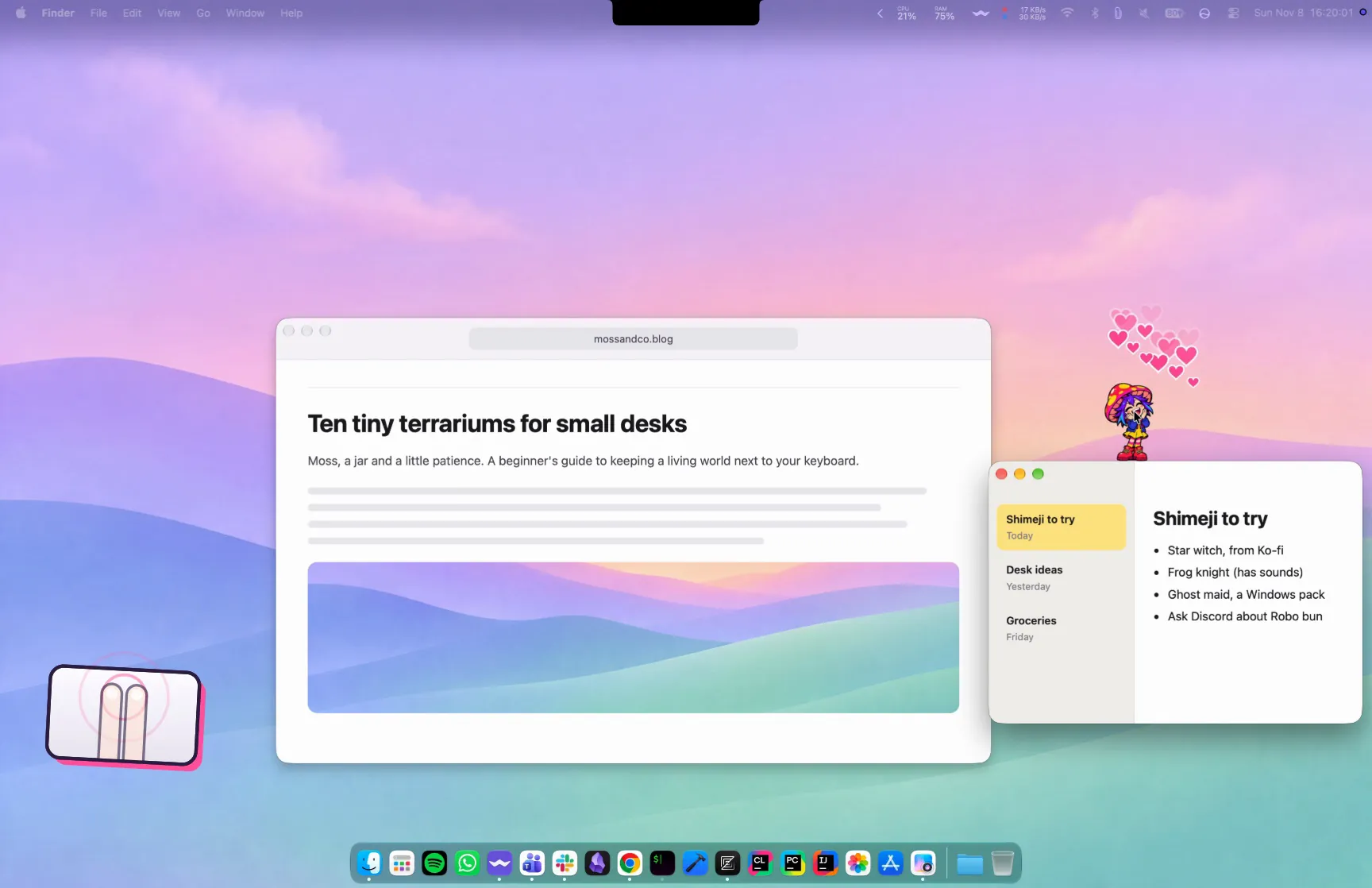
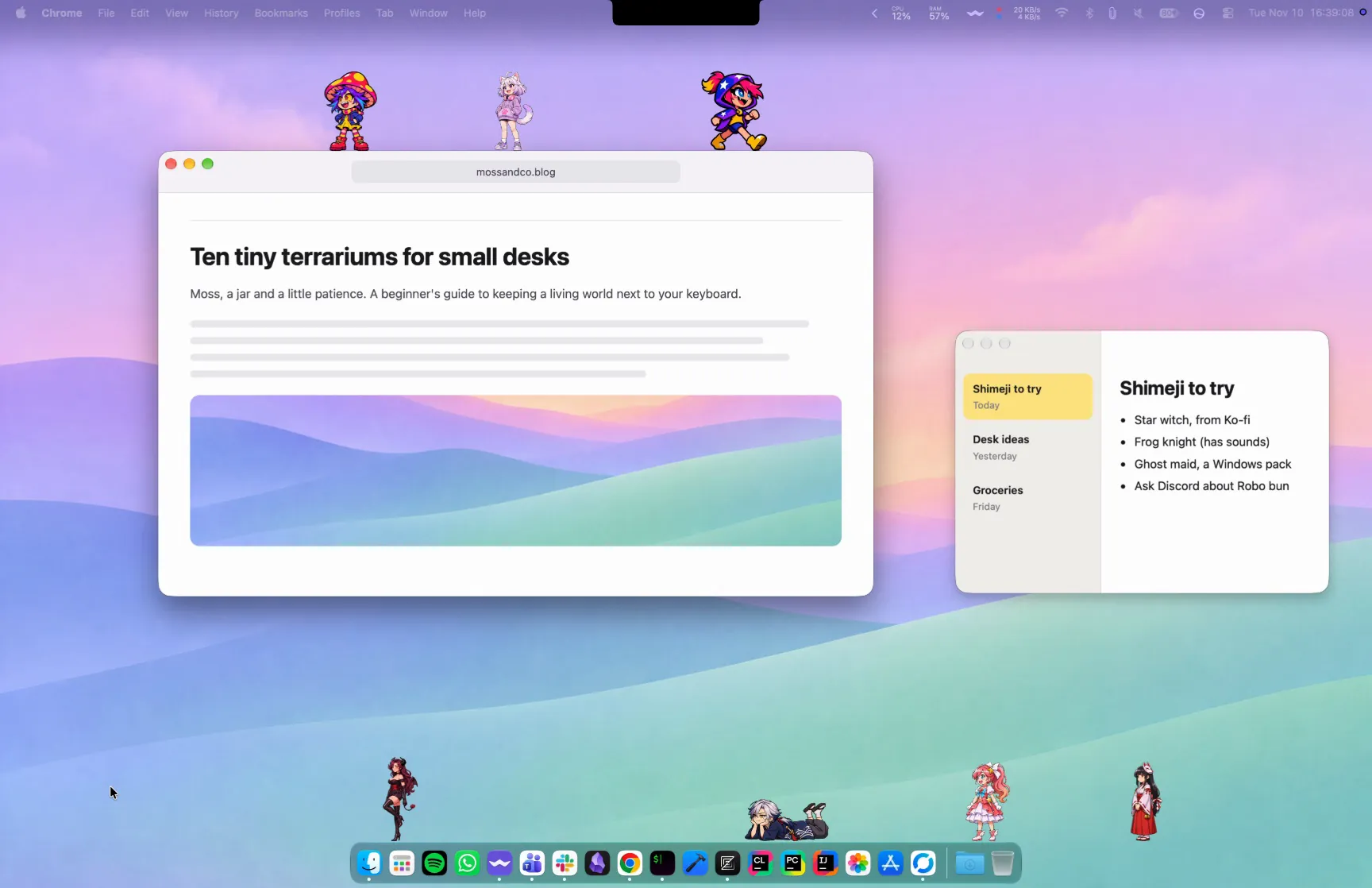
We make Shimejiko, a desktop pet: small characters that walk along the Dock, climb windows and sit on top of them. It adds one shortcut of its own. Option-Command-H (⌥⌘H) hides every character and brings them back, from any app and even in full screen. To pick other keys, choose Shimejiko › Settings (Command-Comma), click the keys beside Hide everyone under General, and press a combination that includes Command, Option or Control; Esc cancels. Our catch: Option-Command-H is also Apple's key for hiding all other apps, so if you rely on that, record different keys.
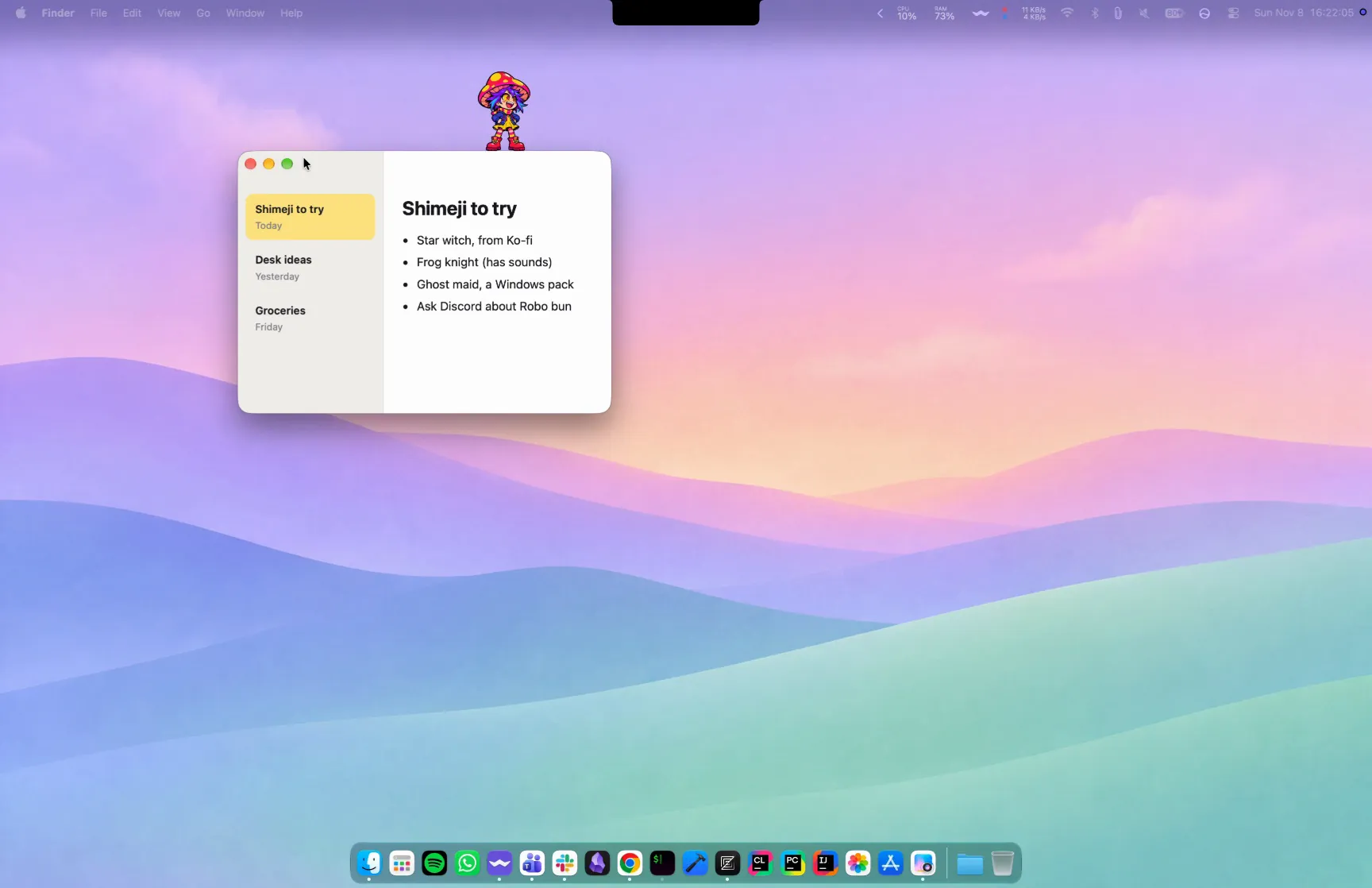
The clip shows Shimejiko riding a Notes window while the pointer drags it around the screen.
Shimejiko is a free download for macOS 14 or later, on Apple silicon and Intel, with one character type on screen at a time. Pro is $5.99 once, on up to 3 Macs (checked 21 November 2026). See what the characters do on a MacBook, more MacBook tips and tricks, or 10 ways to customize your MacBook.
Questions
What is Ctrl-Alt-Delete on a Mac?
Option-Command-Esc opens Force Quit, for an app that has stopped responding. Task Manager's other jobs belong to Activity Monitor, in Applications › Utilities.
How do I right-click with a keyboard on a Mac?
Hold Control while you click. On a trackpad, clicking with two fingers does the same, and Trackpad settings › Secondary click changes it.
Why does a Mac keyboard shortcut do nothing?
Apple's checklist: update the app, add Fn or Globe if the shortcut uses a function key, and look for a warning icon in Keyboard Shortcuts, which means another app already has those keys (Apple).
How do I cut and paste files on a Mac?
Copy them with Command-C, open the new folder and press Option-Command-V. The Finder moves them instead of making copies.