How to right click on a Mac: trackpad, Control-click, Magic Mouse, the keyboard, and what changed from Sonoma to macOS 27

Also in日本語한국어繁體中文简体中文EspañolDeutschPortuguês (Brasil)Français
Quick answer
To right click on a Mac, hold down Control as you click, or click the trackpad with two fingers. On a Magic Mouse, press the right side of its top; a mouse with a right button needs no setup. This guide covers the trackpad's corner options, the keyboard routes Apple documents, the touch screen MacBook Pro, how Apple's pages changed from Sonoma to macOS 27, and what to check when right click stops working.
Download for MacTo right click on a Mac, hold down Control and click, or click the trackpad with two fingers. On a Magic Mouse, press the right side of its top surface; a mouse with a real right button works as it comes. Apple calls this a secondary click, or Control-click, and System Settings › Trackpad or Mouse › Secondary click sets how you do it, including a one-finger press in a bottom corner of the trackpad.
We read every page linked in this guide on 24 November 2026. The comparison puts four editions of Apple's Mac User Guide page Right-click on Mac side by side, for macOS 27 Golden Gate, Tahoe, Sequoia and Sonoma, together with the same four editions of Apple's Trackpad settings, Mouse settings and Mouse Keys pages. Apple's support articles Use Multi-Touch gestures on Mac, published November 20, 2026, and Mac tips for Windows switchers, published April 6, 2026, fill in the gestures. Apple's pages never print the names of the Secondary click choices, so those come from iDownloadBlog's guide, updated July 20, 2026. What Shimejiko does near the end comes from its source code.
Which ways can you right click on a Mac?
| Input | How the right click is done | What controls it |
|---|---|---|
| Any mouse or trackpad, plus the keyboard | Keep Control pressed and click the item | Nothing to set up |
| Built-in trackpad or Magic Trackpad | Click with two fingers, or tap with two if Tap to click is on | Trackpad › Secondary click |
| The same trackpad, one finger | Press the bottom-right or bottom-left corner | Trackpad › Secondary click, once a corner is chosen |
| Magic Mouse | Click the right side of its top | Mouse › Secondary click, which can move it to the left side |
| A mouse with two buttons | Press the right button | Usually nothing; a maker's own app may remap buttons |
| MacBook Pro with PROLED XDR Display | Touch and hold the item on the screen | Accessibility › Touch |
| The keyboard alone | The Contextual Menu key, VoiceOver's VO-Shift-M, or a key you assign | The keyboard section below |
Whichever way you choose, the result is the same: a shortcut menu, which Windows users know as a context menu, with commands for whatever sits under the pointer. Apple's examples are the desktop, icons and files. A few right-click menus are worth knowing: the Dock's, covered in how to customize your Mac's Dock; the floating preview after a screenshot, whose Save to Clipboard is in our screenshot guide; and the one that copies words out of a photo, tip 4 in MacBook tips and tricks. In Bluetooth settings, Control-clicking a device's name and choosing Forget stops it from reconnecting (Apple). Other key combinations live in our Mac keyboard shortcuts list.
How to right click on a Mac trackpad
Apple's gestures article and its Windows switchers article both give a two-finger click as the trackpad's right click. To change the gesture:
- Open System Settings and choose Trackpad in the sidebar, scrolling down if it's out of sight. Apple notes the Trackpad pane needs a Mac with a built-in trackpad or a wireless trackpad that's connected.
- Find Secondary click in the Point & Click section and open its pop-up menu.
- Choose one of the three choices iDownloadBlog names: Click or Tap with Two Fingers, Click in Bottom Right Corner, or Click in Bottom Left Corner.
A few things that trip people up:
- Tapping instead of pressing. A light two-finger tap counts only while Tap to click is on, per Apple's MacBook Pro trackpad page. Otherwise press the trackpad down with both fingers.
- One finger in a corner. The two corner choices turn a single-finger press in that corner into a right click. Apple's Sequoia and Sonoma pages describe it as choosing to Control-click "by clicking with one or two fingers". The pop-up holds one choice at a time, so once a corner is chosen, a two-finger click stops being the right click.
- Two fingers sliding is scrolling, not a right click, and Apple's pointer troubleshooting page adds that two or more fingers never move the pointer.
- Force Click is something else. Pressing until you feel a second, deeper click looks up a word or previews a file. If that keeps happening when you wanted the menu, Apple's MacBook Pro page suggests a firmer Click setting in Trackpad settings, or setting Look up & data detectors to Tap with Three Fingers.
How do you right click with a Magic Mouse or a two-button mouse?
Magic Mouse. Its top is one smooth surface, so the right click is a press on the right half, which Apple's gestures article lists as the secondary click. In System Settings › Mouse, the Secondary click pop-up switches it to the other half; iDownloadBlog calls the choices Click Right Side and Click Left Side, and Apple's guide says to pick whichever side is more comfortable. Apple's Mouse settings page adds that the settings appear only while a wireless mouse is connected. One version catch from the same gestures article: Magic Mouse models with a USB-C port require macOS Sequoia 15.1 or later.
A mouse with two buttons. The right button sends a right click. iDownloadBlog says most wired mice need no setup at all: plug in and press. If yours came with its maker's own app, button assignments may live there, and Apple's Pointer Control page warns that such driver software can keep some macOS pointer settings from working as expected.
How do you right click on a touch screen Mac?
On a MacBook Pro with PROLED XDR Display, Apple's touch gestures page gives touch and hold on an item as the way to open a shortcut menu. The same Mac also has a trackpad, which right-clicks like any other. Touch Display settings change swipes and pinches but list no option for the touch and hold menu.
How do you right click with only the keyboard?
Apple documents five routes, from a dedicated key to facial expressions.
- The Contextual Menu key. Apple's Sequoia, Tahoe and macOS 27 pages name one keyboard that has it: the full-size Magic Keyboard with Touch ID and a numeric keypad, USB-C model, where the key sits below F13 and opens a shortcut menu. Sonoma's page has no such tip.
- A key you assign. Choose Apple menu › System Settings › Accessibility › Pointer Control and turn on Alternate pointer actions. Click the Info button beside it, click Add and follow the prompts to give Right Click a key. Apple says the same list also takes assistive switches and facial expressions seen by the camera, such as a smile, and that a right click happens the moment the key, switch or expression is used.
- VoiceOver. With VoiceOver on (Command-F5), Apple's VoiceOver guide says VO-Shift-M opens the shortcut menu for the item in the VoiceOver cursor. VO means Control and Option pressed together, or Caps Lock.
- Dwell. For eye or head tracking: turn on the Accessibility Keyboard in Accessibility › Keyboard, then its Dwell options, and pick the Right Click action. Resting the pointer on an item for the dwell time then right-clicks it (Apple).
- Mouse Keys. It moves the pointer with 7, 8, 9, U, O, J, K and L (or the keypad), clicks with I or keypad 5, holds the button down with M or 0 and lets go with the period key. None of Apple's four editions of the Mouse Keys page lists a right click key; each points to Alternate pointer actions for that. Whether pressing Control along with I counts as a Control-click, Apple doesn't say, and we haven't tried it. While Mouse Keys is on, the keyboard can't type text.
What changed between macOS 27, Tahoe, Sequoia and Sonoma?
Every edition gives the same ways to right click. What moved between them is Apple's wording, the keyboard key and which hardware is covered:
| macOS 27 | 26 Tahoe | 15 Sequoia | 14 Sonoma | |
|---|---|---|---|---|
| What Apple calls it | Secondary click or Control-click | Same | Same | Same, plus "similar to right-clicking on a Windows computer" |
| Contextual Menu key tip | Yes | Yes | Yes | No |
| Steps for mouse and trackpad | One set covering both | Two sets | Two sets | Two sets |
| How the steps start | Go to the System Settings app | Same as macOS 27 | Apple menu › System Settings | Same as Sequoia |
| Trackpad line "one or two fingers" | Gone | Gone | Yes | Yes |
| Trackpad settings page says it needs a trackpad | Yes | Yes | Yes | Only "depending on the Mac" |
| USB-C Magic Mouse | Supported | Supported | 15.1 or later | No, it needs Sequoia 15.1 |
| Mouse Keys page | Use your keyboard like a mouse | Same | Same | Control the pointer using Mouse Keys |
| Mouse Keys click keys | I or keypad 5 | Same | Same | Same |
| Trackpad page links the pointer troubleshooter | Yes | Yes | No | No |
Sources: the four Right-click on Mac pages linked at the top, the Trackpad settings pages for macOS 27, Tahoe, Sequoia and Sonoma, the four Mouse settings and Mouse Keys pages (Sonoma's has the older title), and the gestures article for the USB-C Magic Mouse row.
Two of these changes are worth a note. Tahoe dropped the "one or two fingers" sentence from its trackpad steps, yet iDownloadBlog's guide, updated in July 2026, still lists both corner choices, so we read it as an edit to the page, not a removed option; we haven't checked the pop-up on a Mac running each version. And macOS 27 folded the mouse and trackpad steps into one, adding "On a mouse" before the right or left side choice, since that choice exists only for a mouse.
Why won't right click work on my Mac?
Work down this list:
- The gesture isn't what you think it is. With a corner chosen under Secondary click, two fingers won't open the menu, and on a Magic Mouse the side may have been switched. Open the pop-up in Trackpad or Mouse settings and check.
- There's no Secondary click setting at all. Apple says Mouse settings show only while a wireless mouse is connected, and Trackpad settings need a built-in or connected trackpad. Reconnect it first.
- Control-click does nothing. Somebody may have remapped Control. In System Settings › Keyboard, click Keyboard Shortcuts, then Modifier Keys, and check that Control does Control; Restore Defaults puts every key back (Apple).
- The built-in trackpad ignores you while a mouse is plugged in. Accessibility › Pointer Control has Ignore built-in trackpad when mouse or wireless trackpad is present. Turn it off.
- Letters won't type and the trackpad is dead. Mouse Keys may have come on. Its options include toggling it by pressing Option five times and ignoring the built-in trackpad while it's on; press Option five times again, or turn it off in Pointer Control.
- The pointer won't move on a laptop's trackpad. Apple's troubleshooter says to use one finger, and that a low battery alert you can't see may be the cause: plug the Mac in, or connect an external keyboard to see the alert.
- Touch and hold does nothing on a touch screen MacBook Pro. Check that Ignore Touch Gestures is off in Accessibility › Touch (Apple).
- A third-party mouse misbehaves. Its maker's app may own the buttons, and iDownloadBlog suggests checking that the mouse supports macOS and asking the maker about firmware updates.
- Still stuck. iDownloadBlog's last steps are a restart and System Settings › General › Software Update. If a trackpad still doesn't respond, Apple's advice is service from Apple or an Apple Authorized Service Provider.
What happens when you right click a Shimejiko character?
We make Shimejiko, a desktop pet for Mac: small characters that walk along the Dock, climb windows and nap. Right click matters here, because a character's menu is where you call more of them or send one away. This is what the code does, read from the source, not tested on a Mac.
- A right click on a character opens its menu. At the top is the character's name, then Do something (the pack's own moves), Call another, Find on screen (a scribbled circle drawn around it for three seconds), Dismiss, Dismiss every copy of it, Hide everyone, Open in Library and Settings. Do something lists every move the pack doesn't mark as hidden; turning off Settings › Behaviors › Right-click moves, which is on by default, removes that submenu. On the free plan, Call another stops at 3 copies with a note that your screen is full. Our guides to using Shimeji and removing characters walk through each item.
- Every secondary click that reaches the app as a right-button press opens it: two fingers on the trackpad, a corner you've set, the right side of a Magic Mouse, a mouse's right button.
- A Control-click doesn't. The menu is wired to the right-button event alone. A Control-click arrives as an ordinary click with Control held, and the click handler doesn't check for Control, so it picks the character up as a plain click would. If your Mac has no secondary click set up, the desktop menu is out of reach until you set one.
- Two fingers do two jobs over a character. A two-finger click opens the menu; a two-finger stroke pets it, with hearts and, on a Force Touch trackpad, a purr you feel (Settings › Mac magic › Purr). A Force Click boops it. Hearts rise over any character, and on the free plan Shimejiko herself is the one who also plays a reaction.
- The menu bar mushroom has no right-click menu. The app asks for both left and right clicks on its icon and opens the same panel either way; Option-click hides or shows everyone. The code checks only for Option, so a Control-click should open the panel too.
- In the app's window, it's the usual Mac menu. Each card in the Library carries a standard menu, which a right click opens and macOS normally opens on a Control-click as well: Put on screen, Open test bench, Add to Favorites and, for packs you imported, Rename, Re-import, Show in Finder and Delete. The card's ⋯ button opens the same list.
- Right clicks don't count as knocks. A firm click can jolt a MacBook the way a light knock does, so Knock ignores anything within a quarter of a second of a key press or a click of any button.
The drawback is the flip side of that menu. Characters take clicks only over their own drawn pixels, and everything else passes through to the app below, but a character standing on a file icon or a window's button gets the right click meant for it. Drag the character aside, or press ⌥⌘H (Option-Command-H) to hide everyone from any app and again to bring them back. On a Mac with no secondary click set up, the app's Crew screen covers most of the menu, with buttons to find, pause, call another and dismiss each character; telling one to play a particular move from its pack is the job only the right-click menu does.
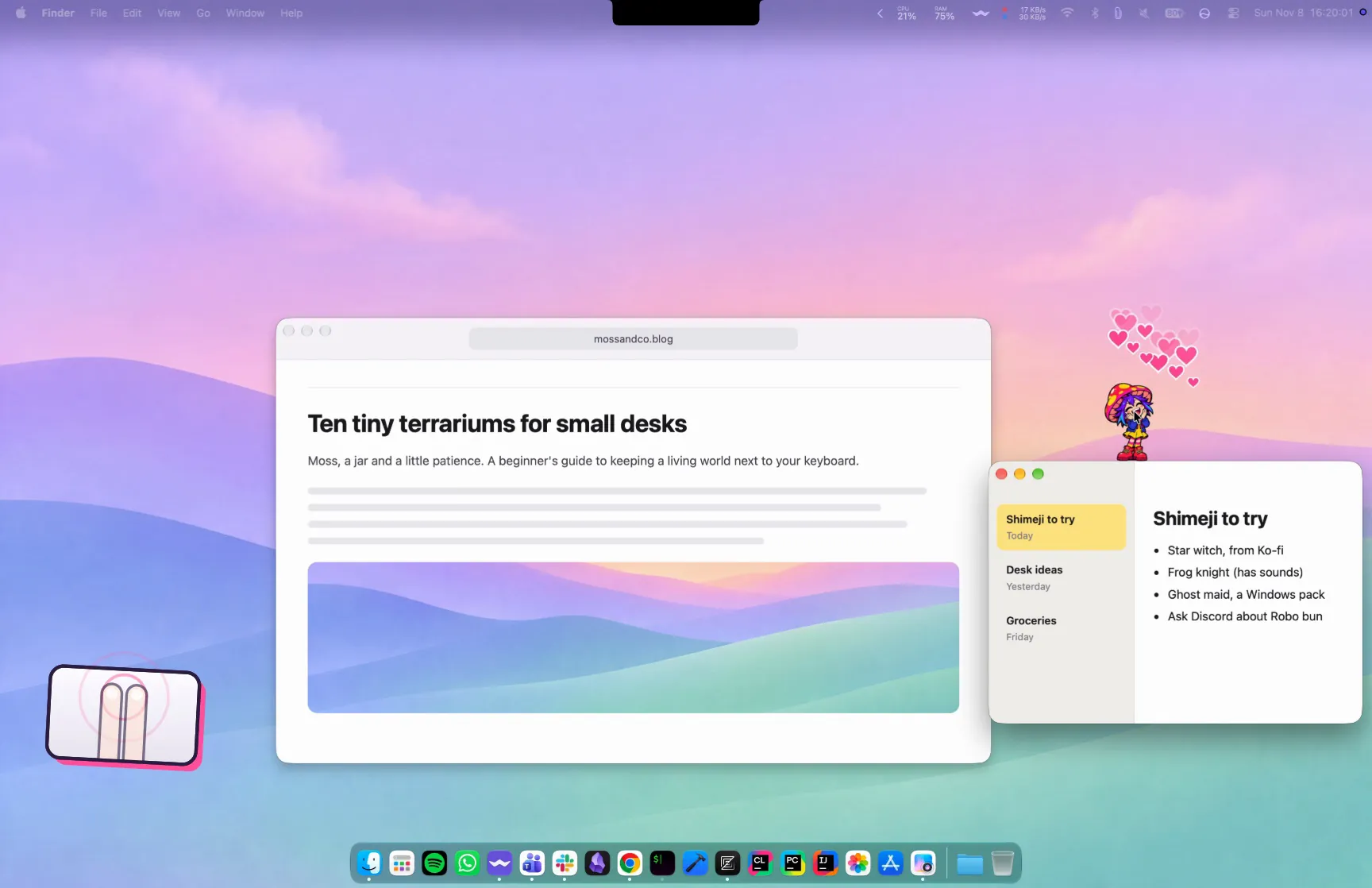
Recorded in the app, the clip shows the stroke, not the click: two fingers sliding over Shimejiko pet her, where the same two fingers pressing down would open her menu. More of what the crew does on a laptop is in Shimejiko on a MacBook.
Shimejiko is free for macOS 14 Sonoma or later, on Apple silicon and Intel, with one character type on screen at a time and up to 3 copies of it. Pro costs $5.99 once, works on up to 3 Macs and lets the whole crew out together (checked 2026-11-24 on shimejiko.app). Get Shimejiko, or set it up to stay calm while you work.
Questions
What is a right click called on a Mac?
Apple calls it a secondary click or a Control-click, and the menu it opens a shortcut menu. Sonoma's guide adds that Control-clicking is similar to right-clicking on Windows.
How do you right click on a Mac without a mouse?
On a MacBook, click the trackpad with two fingers, or keep Control pressed while you click it. From the keyboard, use the Contextual Menu key on the USB-C Magic Keyboard with Touch ID and numeric keypad, VO-Shift-M with VoiceOver on, or a key assigned under Alternate pointer actions, which right-clicks wherever the pointer is.
How do you right click with one finger on a MacBook?
Set System Settings › Trackpad › Secondary click to Click in Bottom Right Corner or Click in Bottom Left Corner, then press that corner with one finger.
Why does my Mac open a menu when I click with two fingers?
That's the secondary click, the two-finger gesture Apple's gestures article lists for trackpads. To keep two-finger clicks from opening menus, choose a corner instead under Secondary click.