Stage Manager on Mac: how to turn it on or off, use groups and the strip, and what changed from Ventura to macOS 27

Also in日本語한국어繁體中文简体中文EspañolDeutschPortuguês (Brasil)Français
Quick answer
To turn on Stage Manager on a Mac, click Control Center in the menu bar and then Stage Manager, or use the Stage Manager switch in System Settings › Desktop & Dock; either one turns it off again. The app you're using moves to the center, recent apps wait in a strip on the left, and dragging one onto the center groups them. This guide compares Apple's steps for macOS 27, Tahoe, Sequoia and Sonoma and explains why people switch it off.
Download for MacTo turn on Stage Manager on a Mac, click Control Center in the menu bar, then click Stage Manager. The window you're using slides to the middle of the screen and your other recent apps shrink into a strip on the left: click one to switch to it, or drag it onto the middle to work with both. Click Stage Manager in Control Center again to turn it off.
Sources, all read on 23 November 2026: Apple's page "Organize your Mac desktop with Stage Manager" in five editions of the Mac User Guide, macOS 27 Golden Gate, Tahoe 26, Sequoia 15, Sonoma 14 and Ventura 13, the Desktop & Dock settings pages for the four newer versions, Apple's Mac keyboard shortcuts article (published September 14, 2026) and every other page linked below. Apple's Stage Manager pages for macOS 27 and Tahoe are word for word the same. What Shimejiko does comes from its code, version 1.4.0.
How do you turn Stage Manager on or off?
Each of these routes works both ways:
- Control Center: click Control Center in the menu bar, then click Stage Manager. Apple says the button is always there, from Ventura through macOS 27.
- System Settings: choose Apple menu › System Settings, click Desktop & Dock in the sidebar, go to the section called Desktop & Stage Manager and flip the Stage Manager switch. On Ventura the switch lives under Windows & Apps instead.
- The keyboard, nearly: Apple's shortcut list gives Stage Manager no key of its own. On keyboards with an Fn or Globe key, it does list Fn-C (Globe-C) to show Control Center, where Stage Manager is one click away. More keys like that one are in our Mac keyboard shortcuts guide.
One guide in today's results says you can give Stage Manager its own key under Keyboard settings. Apple doesn't document that, and we haven't tried it.
To reach it in one click, add a Stage Manager icon to the menu bar:
- macOS 27 and Tahoe: click Control Center, then Edit Controls. Under Desktop & Finder, rest the pointer on Stage Manager, click the More button, choose Add to Menu Bar and click Done.
- Sequoia, Sonoma and Ventura: open System Settings, click Control Center in the sidebar, then pick Show in Menu Bar from the pop-up menu next to Stage Manager.
Why won't Stage Manager turn on?
Apple gives one fix: open System Settings › Desktop & Dock, scroll down to Mission Control and turn on Displays have separate Spaces. Apple's Desktop & Dock pages for macOS 27, Tahoe and Sequoia say the Stage Manager switch stays dimmed without it, and that Split View on a second display needs it too.
Sonoma's pages never link the two: its Stage Manager page has no such note, and its description of Displays have separate Spaces mentions only Split View. We followed the newer pages, so if the switch won't move on Sonoma, check that setting first anyway.
How do you use Stage Manager on a Mac?
Apple lists four moves, and its shortcut article adds two keys that help:
- Switch apps: click an app in the strip. Command-Tab still jumps to the app you used most recently, as appsntips showed when the feature was new.
- Arrange the stage: move, resize and overlap the windows in the middle any way you like. Stage Manager itself snaps nothing into place; if you want halves and quarters, split screen on Mac covers tiling and when Stage Manager suits a job better.
- Build a group: drag an app from the strip onto the center. It joins whatever is already there, and the whole set comes back together each time you click that group in the strip.
- Take an app out: drag it from the center and drop it on the strip.
- Step through one app's windows: Command-Grave accent (`) brings up the front app's next window. With One at a Time chosen (see the settings below), clicking that app in the strip a second time does the same.
- Bring back a hidden strip: if Show recent apps in Stage Manager is off, push the pointer against the left edge of the screen and the strip slides out for a moment.
Which Stage Manager settings can you change?
All of them are in System Settings › Desktop & Dock. The names here are the ones macOS 27 and Tahoe show:
| Setting | Section | What it changes |
|---|---|---|
| Stage Manager | Desktop & Stage Manager | Turns the feature on or off |
| Show recent apps in Stage Manager | Desktop & Stage Manager | Off hides the strip until the pointer reaches the left edge |
| Show windows from an application | Desktop & Stage Manager | All at Once brings every window of an app when you switch to it; One at a Time brings only the last one you used |
| Show Items: In Stage Manager | Desktop & Stage Manager | Keeps files and folders on the desktop visible while Stage Manager runs; unselected, they stay hidden until you click the desktop |
| Show Desktop | Desktop & Stage Manager | Always on Wallpaper Click moves every window aside when you click the wallpaper; Only in Stage Manager on Click does that only while Stage Manager is on |
| Show Widgets: In Stage Manager | Widgets | Lets desktop widgets show while Stage Manager is on |
| Displays have separate Spaces | Mission Control | Needed before Stage Manager will turn on |
The On Desktop boxes next to Show Items and Show Widgets cover the same things for when Stage Manager is off. Widgets have more options of their own, such as dimming, in our Mac widgets guide.
What changed between Ventura, Sonoma, Sequoia, Tahoe and macOS 27?
Stage Manager behaves the same in all five versions; what moved is where Apple keeps its settings and what it calls them. That matters because many of the guides near the top of Google today were written for Ventura, macOS 13, and Ventura's own steps send you to a Windows & Apps section and a Customize button that no later version has. Compared line by line from Apple's five editions of the Stage Manager page and the Desktop & Dock pages for macOS 27, Tahoe, Sequoia and Sonoma:
| macOS 27 and 26 Tahoe | 15 Sequoia | 14 Sonoma | 13 Ventura | |
|---|---|---|---|---|
| Where the on and off switch is | Desktop & Dock › Desktop & Stage Manager | Same | Same | Desktop & Dock › Windows & Apps |
| Where its other settings are | In the same section, in the open | Same | Same | Behind a Customize button next to Stage Manager, closed with Done |
| The strip's setting | Show recent apps in Stage Manager | Same | Same | Recent applications |
| Desktop files while it's on | Show Items: In Stage Manager | Same | Same | Desktop items |
| What a wallpaper click does | Show Desktop: Always on Wallpaper Click, or Only in Stage Manager on Click | Click wallpaper to reveal desktop: Always, or Only in Stage Manager | Same as Sequoia | Not on Apple's Ventura page |
| Widgets while it's on | Show Widgets: In Stage Manager | Same | Same | Not on Apple's Ventura page |
| Putting it in the menu bar | Control Center › Edit Controls › Desktop & Finder | System Settings › Control Center › Show in Menu Bar | Same as Sequoia | Same as Sequoia |
| Apple's note for a switch that won't turn on | Turn on Displays have separate Spaces | Same | None | None |
| An app's several windows | All at Once or One at a Time | Same | Same | Same |
The wallpaper setting got the biggest rename, but not a new job. Apple's description of Tahoe's two choices matches Sequoia's word for word apart from the names, so Always on Wallpaper Click is the old Always, and Only in Stage Manager on Click is the old Only in Stage Manager.
What do you need for Stage Manager on two displays?
The same Displays have separate Spaces setting. Apple's Desktop & Dock page adds that with it on, the Dock is available on every display, and with it off, the Dock shows only on the main one. That is all Apple's guides say: none of the five editions describes how the strip or groups behave across two screens, and we haven't tested it, so we won't guess. To move or resize the Dock itself, see how to customize your Mac's Dock.
Why do people turn Stage Manager off?
Most of the complaints below have a setting that answers them, so look here before you give up on it:
| What bothers you | Why it happens | What to try |
|---|---|---|
| The strip takes up the left side of a small screen | Recent apps line up along the left | Turn off Show recent apps in Stage Manager and call the strip up from the left edge when you need it |
| Desktop files are gone | In Stage Manager isn't selected next to Show Items | Select it, or click the desktop to see the files for a moment |
| Windows fly aside when you click the wallpaper, even with Stage Manager off | Show Desktop is set to Always on Wallpaper Click | Choose Only in Stage Manager on Click, or Only in Stage Manager on Sequoia and Sonoma; switching Stage Manager off doesn't change this |
| An app's other windows vanish when you switch to it | Show windows from an application is set to One at a Time | Choose All at Once |
| Every window needs sizing by hand | Stage Manager doesn't size windows for you | If you'd rather have halves and quarters, turn it off and tile, as in split screen on Mac |
| Recording the screen makes System Settings hang or drops a menu from the video | A bug one developer reported on Tahoe | Turn Stage Manager off while you record |
And three accounts from people who wrote about it:
- Recording on Tahoe. Rob Griffiths of The Robservatory wrote on April 16, 2026 that while recording with ScreenFlow on Tahoe 26.4.1, System Settings took about 30 seconds to answer his clicks, and a pop-up menu showed in roughly one frame of 20, in Apple's built-in recording as well as ScreenFlow. With Stage Manager off, both problems went away. He filed a report with Apple, and Telestream, which makes ScreenFlow, saw the same hang on 26.3.1. We don't know whether macOS 27 fixed it. Apple's own recording tools are in how to screenshot on a Mac.
- Groups take work. The author of aung.tech, in November 2022, switched it on and off for a month and ended up feeling like a tester rather than a user. The post asks for Mission Control to show the same groups as the strip, and notes that opening a new app sends the one in the center to the strip instead of grouping the two.
- Animations and the desktop. appsntips, writing in June 2022, called it an iPad-first feature and found the long animations and the hidden desktop files the most annoying parts. Apple's Ventura page already lists a switch for the second, Desktop items; later versions call it In Stage Manager, next to Show Items.
For more time-savers on a laptop screen, see our MacBook tips and tricks.
What do Shimejiko's characters do with Stage Manager on?
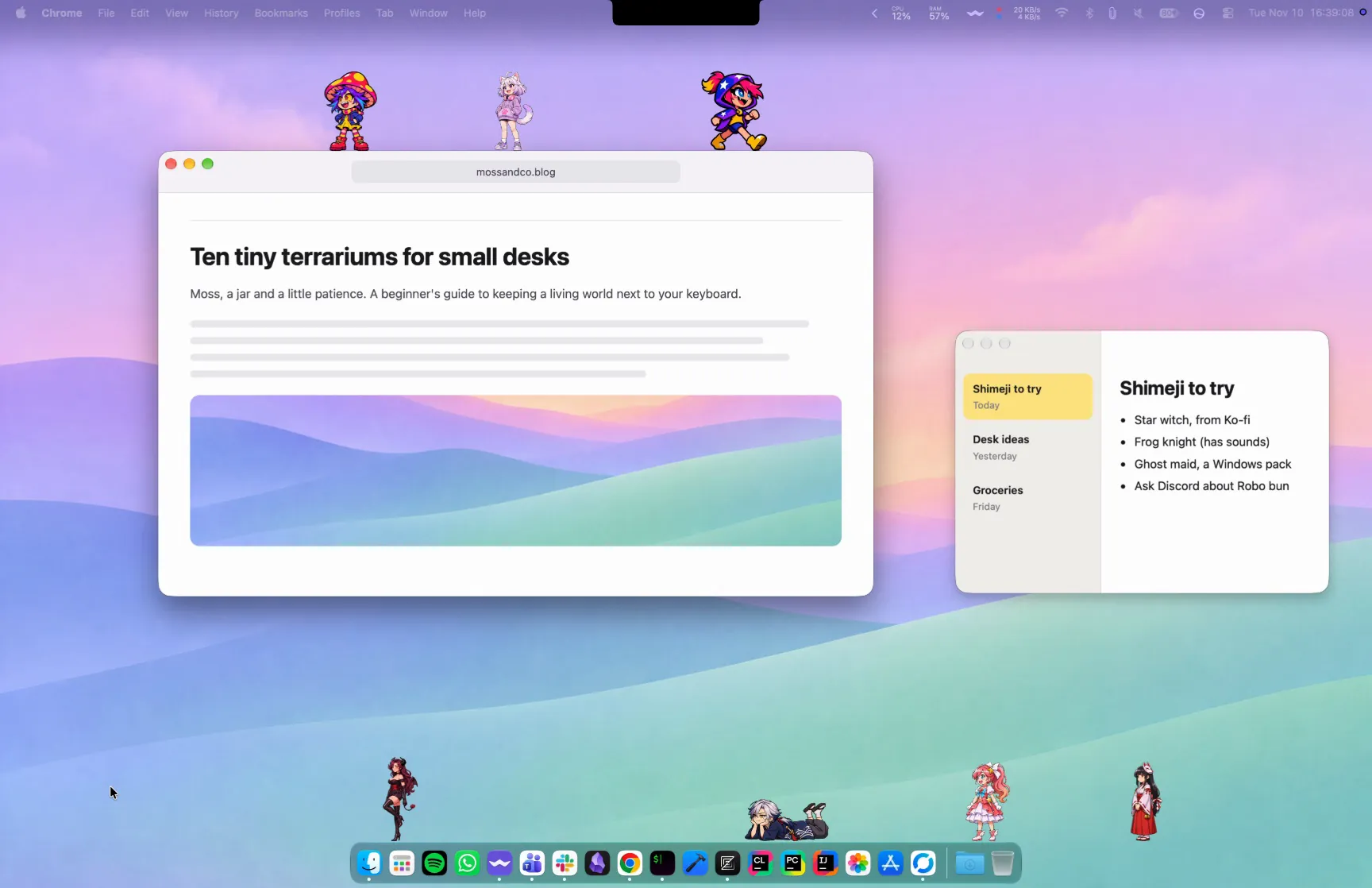
We make Shimejiko, a desktop pet for Mac: small characters that walk along the Dock and climb, sit on and ride the window you're using. Nothing in its code mentions Stage Manager, and we haven't tested the two together. Here is what the code does with windows, and what follows from that:
- They live above the stage. Characters are drawn in one transparent panel per display, at the status-bar window level above ordinary app windows, on every Space, and left out of Command-Tab and Mission Control. Clicks pass through it except on a character's own pixels. The app doesn't hide that panel for Stage Manager; under Settings › Auto-hide it steps aside only for presentations, full-screen video, screen sharing or recording and, with Pro, a schedule.
- They climb only the window in front. Ten times a second the app reads the list of windows on screen, by position, size and owner only, and keeps the topmost window of the app you're using that measures at least 120 by 80 points. With Stage Manager on, that should be the window you're working in at the center, and in a group, only the app you clicked last. The thumbnails in the strip belong to apps that aren't in front, so the code never offers them as ledges.
- Switching drops them. Once another window comes to the front, the engine stops following the old one. A character standing on it falls, unless the new window's top edge happens to be right under its feet, and lands on whatever is below: the new window, the Dock or the bottom of the screen.
- The catch is the left edge. Characters also climb the sides of the screen, including the left one where the strip sits, and their layer floats above ordinary windows. If one parks over a thumbnail, a click on it may pick up the character instead of switching apps; we haven't checked how macOS stacks the two. Drag it somewhere else, or press ⌥⌘H (Option-Command-H) to hide everyone, from any app, and again to bring them back.
- Throwing moves your layout. If you've granted Window access, the app's Accessibility permission, friends can throw the front window, which undoes a stage you arranged by hand. Switch off Throw windows in Settings › Behaviors, or turn on Calm mode from the menu bar. Climbing works without any permission.
Since Stage Manager needs Displays have separate Spaces, one more note for two screens: the free plan keeps everyone on the main display, and Pro lets them walk across displays (Shimeji on several monitors).
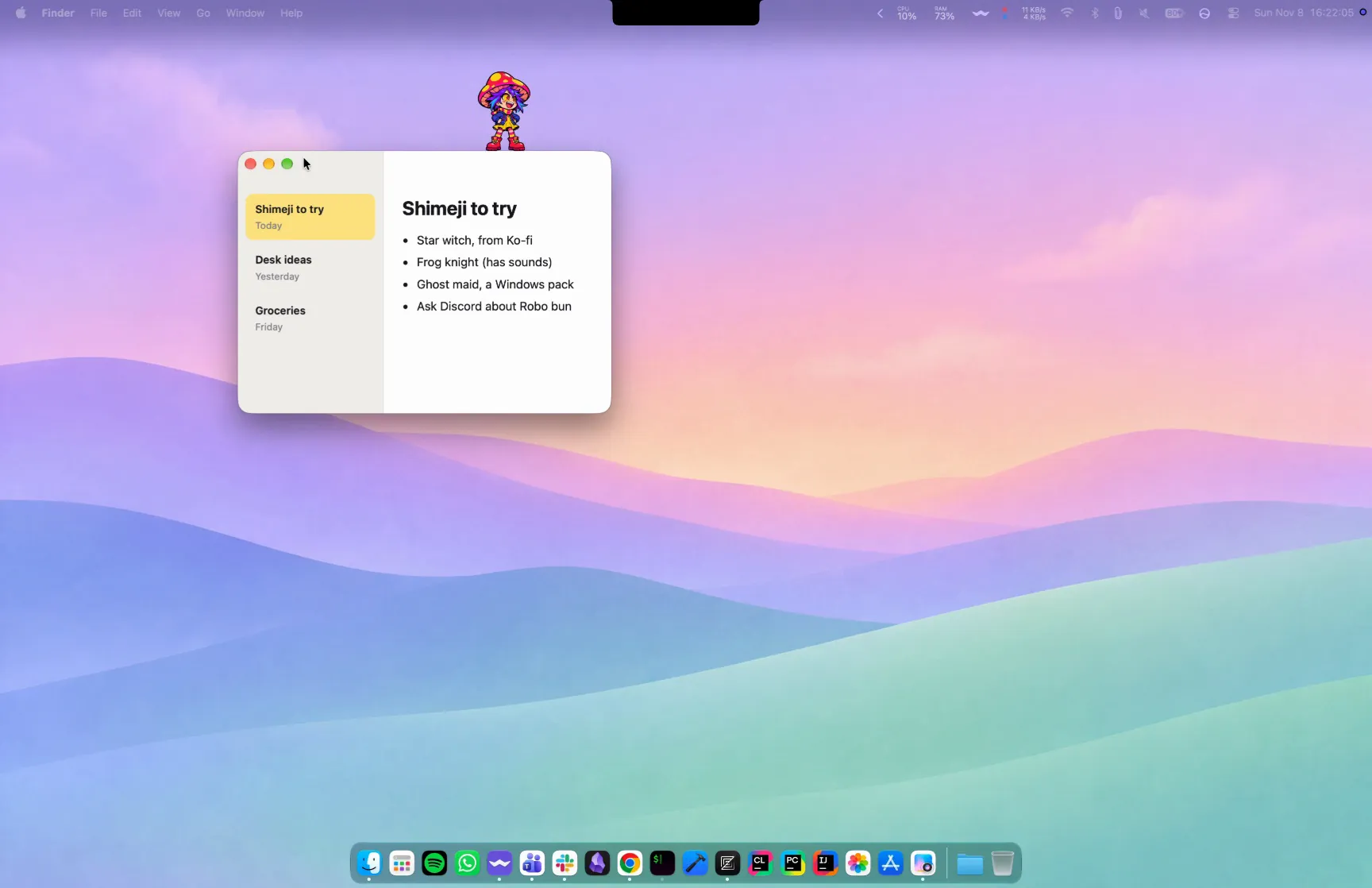
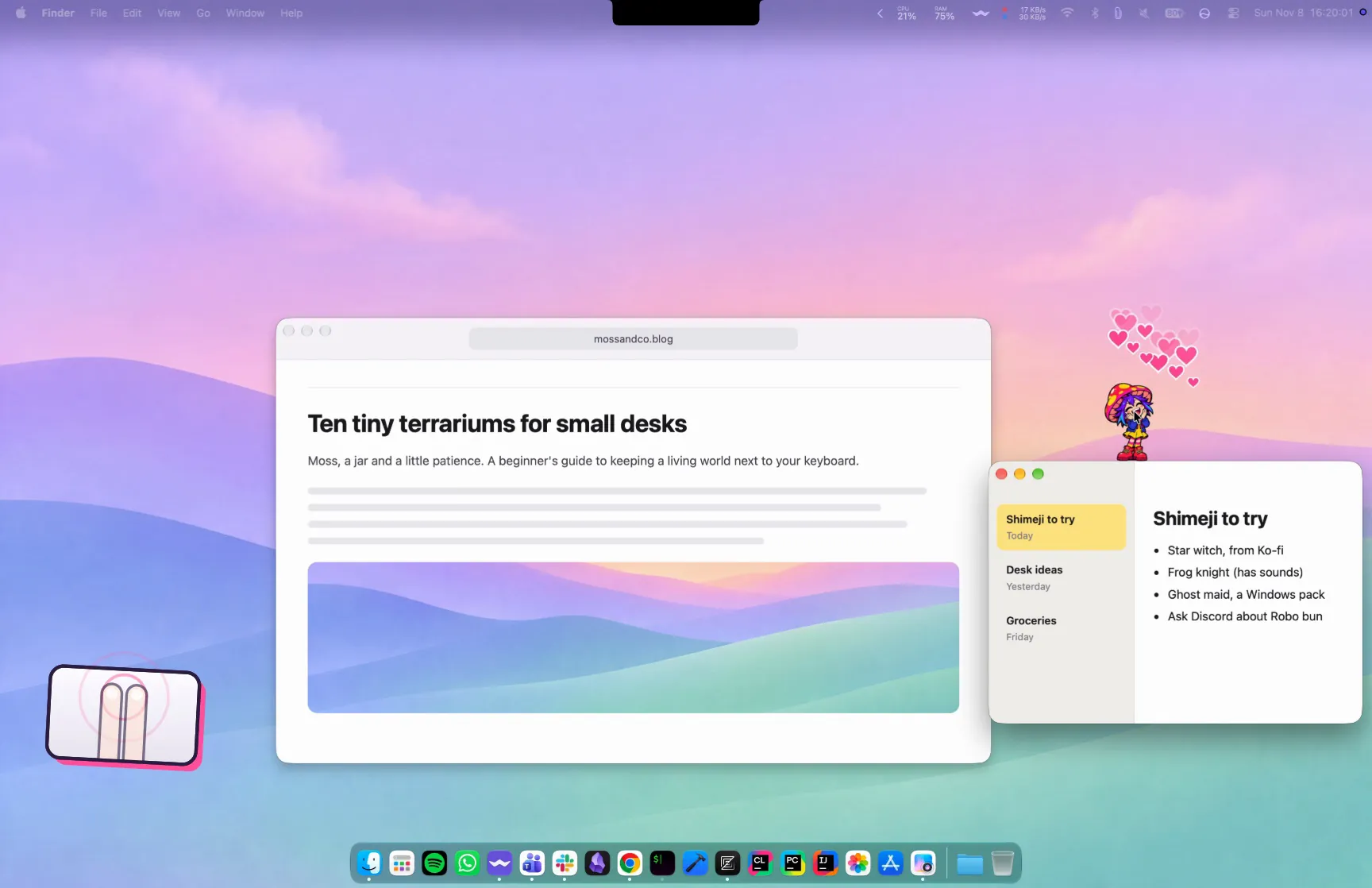
The clip, from the app's own recordings, shows Shimejiko riding a Notes window while it's dragged. We haven't filmed her with Stage Manager on, where the code should point her at the window in the center of the stage.
Shimejiko is free for macOS 14 Sonoma or later on Apple silicon and Intel, with one character type on screen at a time, up to 3 copies. Pro costs $5.99 once, works on up to 3 Macs and lets every type out together (checked 2026-11-23). Get Shimejiko, or set up a crew that stays quiet while you work.
Questions
How do I close Stage Manager on a Mac?
Click Control Center in the menu bar, then Stage Manager, or turn off the Stage Manager switch in System Settings › Desktop & Dock. If windows still move aside when you click the wallpaper, set Show Desktop to Only in Stage Manager on Click.
Is there a keyboard shortcut for Stage Manager?
Not in Apple's list. Fn-C (Globe-C) shows Control Center, where Stage Manager is a click away, and a Stage Manager icon in the menu bar saves another step.
Why is Stage Manager grayed out on my Mac?
Apple's pages for macOS 27, Tahoe and Sequoia give one cause: Displays have separate Spaces is off. Turn it on in the Mission Control section of System Settings › Desktop & Dock.
Where did my desktop icons go in Stage Manager?
They're hidden while it's on unless In Stage Manager is selected next to Show Items in Desktop & Dock. To reach them without changing anything, click the desktop.