Show hidden files on Mac: the Finder shortcut, the Library folder and Terminal commands on macOS 27, Tahoe, Sequoia and Sonoma

Also in日本語한국어繁體中文简体中文EspañolDeutschPortuguês (Brasil)Français
Quick answer
To show hidden files on a Mac, open a Finder window and press Shift-Command-Period; the same keys hide them again and also work in Open and Save dialogs. For your Library folder alone, hold Option and choose Go › Library. This guide says which routes Apple documents for macOS 27, Tahoe, Sequoia and Sonoma, what the Terminal commands defaults and chflags really change, and which hidden folders to leave alone.
Download for MacTo show hidden files on a Mac, open a Finder window and press Shift-Command-Period. Items whose names begin with a dot, and folders macOS marks as hidden, appear in a paler shade; press the same three keys to hide them again. They also work inside an app's Open and Save dialogs. To reach only your Library folder, hold Option while the Finder's Go menu is open and choose Library.
Every Apple page linked in this guide was read on 24 November 2026. We found no Mac User Guide page about hidden files as such, so we took the three that deal with hidden places and compared each in four editions: Go directly to a specific folder for macOS 27 Golden Gate, Tahoe, Sequoia and Sonoma, Folders that come with your Mac and Rename files, folders, and disks, plus Apple's Mac keyboard shortcuts article, published September 14, 2026. For what the Finder hides and why, we used Apple's developer File System Programming Guide, last updated April 9, 2018. For Terminal, we read the manual pages for chflags, ls and killall in Apple's open-source repositories, and the defaults manual that ships with macOS in a web copy. Anything that comes from someone other than Apple is credited to them. Shimejiko's part comes from the app's source code.
How do you show hidden files on a Mac?
There are seven routes, and they differ in how much they reveal and for how long:
| Route | What you see | How long | Who documents it |
|---|---|---|---|
| Shift-Command-Period in a Finder window | Every hidden item, in every Finder window | Until you press the keys again | Not Apple: OS X Daily and Mac Install Guide |
| Shift-Command-Period in an Open or Save dialog | Hidden items in that dialog | Until you press it again | Not Apple: OS X Daily, 2011 |
| Hold Option, then Go › Library | Your own Library folder | That window | Apple, all four versions |
| Go › Go to Folder, then type a path | Any folder whose path you know | That window | Apple, all four versions |
defaults write com.apple.finder AppleShowAllFiles -bool true |
Every hidden item | Until you undo it | The tool is Apple's; the setting's name isn't on any Apple page we read |
chflags nohidden ~/Library |
The Library folder, from then on | Until you hide it again | The flag is in Apple's chflags manual |
ls -a in Terminal |
Dot files, as a text list | One command | Apple's Command Line Primer |
Apple never names the shortcut. Its keyboard shortcuts article lists dozens of Finder keys and has no Shift-Command-Period, and none of the user guide pages we compared mentions it. What Apple's developer pages do confirm is the behavior around it. The Finder and the Open and Save panels hide every name that starts with a period, a group of Unix folders, the /Volumes folder and, since version 10.7, the Library folder inside your home folder. An app's Open or Save panel shows hidden files only when its showsHiddenFiles setting is on, and Apple gives its default as off.
The key combination itself has a long public record outside Apple. OS X Daily described it for Open and Save dialogs in March 2011 and for Finder windows in February 2018, for macOS Sierra and later, noting that revealed items show faded names and icons. Mac Install Guide says its page was tested on macOS 27 Golden Gate in September 2026. We had no Mac to try it on, so the steps above are theirs and Apple's, not our test.
How do you open the Library folder on a Mac?
Apple's route, the same in the macOS 27, Tahoe, Sequoia and Sonoma editions of its Go to a folder page:
- Click the desktop or a Finder window, so the Finder is the app in front.
- Click Go in the menu bar.
- Press and hold Option. Library appears in the menu; choose it.
Apple uses the same steps in its own troubleshooting. Its article on Logic Pro plug-ins that don't show up, published April 10, 2025, has you hold Option, choose Go › Library and find a folder inside Caches.
The second way is to type the path. Choose Go › Go to Folder, which Apple's shortcut list puts on Shift-Command-G, and type ~/Library. Apple's page explains the rules of that box: a tilde (~) stands for your home folder, a slash at the start means the top level of the disk, Tab accepts a suggested path, and the arrow keys step through suggested and recent ones. It opens any folder you can name, hidden or not, such as the one where Stickies keeps notes, which our sticky notes guide traces. More Finder keys are in Mac keyboard shortcuts.
There are three Library folders, and only one is hidden:
| Folder | What Apple says it's for | Hidden? |
|---|---|---|
~/Library, in your home folder |
Files apps keep for you alone: support files, caches, preferences | Yes, since version 10.7 |
/Library, at the top of the disk |
Fonts and other items apps use for every user of the Mac | No |
/System/Library |
Reserved for Apple; the System folder holds macOS, and you can't rename or move it or anything in it | No |
Some guides also point to a Show Library Folder checkbox in View › Show View Options for your home folder. Apple's view options page for these four versions doesn't mention one, and we couldn't look, so rely on the Go menu.
Which Terminal commands show hidden files, and what does each change?
Apple's Terminal guide gives two ways to open it: search for Terminal in Spotlight, or open the Utilities folder inside Applications and double-click it. Paste one block at a time and press Return.
Show everything with defaults
defaults write com.apple.finder AppleShowAllFiles -bool true
killall Finder
The defaults manual describes the tool as a way to read, write and delete the settings apps keep between launches. The first line writes a setting named AppleShowAllFiles, with the value true, into the Finder's settings, whose domain is com.apple.finder; -bool stores it as a true or false value rather than as text. That setting name appears in no Apple page we read. It comes from years of Mac users and guides, including OS X Daily and Mac Install Guide, which says the change survives a restart.
The second line matters because of a warning in the same manual: if you change the settings of an app that's running, it won't see the change and might even write over it. killall stops every process with a given name, with a TERM signal unless you say otherwise, according to its manual. Mac Install Guide adds that macOS reopens the Finder at once, and the fresh Finder reads the new value.
To undo it:
defaults delete com.apple.finder AppleShowAllFiles
killall Finder
delete removes that one setting, per the manual, so the Finder falls back to hiding things. Writing -bool false instead, as Mac Install Guide does, gives the same view. The same tool reaches settings Apple doesn't document elsewhere, such as the screenshot options in our screenshot guide, and the same caution applies.
Unhide only the Library with chflags
chflags nohidden ~/Library
chflags changes the flags stored on a file or folder. Apple's manual lists one called hidden and describes it in four words: "Hide item from GUI". Putting "no" in front of a flag's name clears it, so this line takes the hidden flag off your Library folder and the Finder shows it like any other. chflags hidden ~/Library puts it back. Unlike defaults, nothing about the Finder changes: the flag belongs to that one folder. Leave out the -R option here, which applies a change to everything inside a folder too. The idea of using it on Library comes from guides such as Mac Install Guide; Apple's manual documents the flag, not that particular use.
List hidden files with ls
ls -a ~
ls -lO ~
The first line lists your home folder with every entry, dot files included; Apple's Command Line Primer says -a lists all directory contents, including hidden files and folders. The first two names you'll see, . and .., are the folder itself and the one above it, as Apple's Terminal guide explains. The second line adds file flags to a long listing, per the ls manual, which is how you can check whether Library carries hidden. Neither line changes anything.
What changed between macOS 27, Tahoe, Sequoia and Sonoma?
For hidden files, almost nothing on Apple's pages. The Option and Go › Library tip and the Go to Folder steps are word for word the same in all four editions. The differences sit around them:
| macOS 27 | 26 Tahoe | 15 Sequoia | 14 Sonoma | |
|---|---|---|---|---|
| Hold Option, then Go › Library | Yes | Yes | Yes | Yes |
| Go to Folder steps, tilde and Tab | Same | Same | Same | Same |
| Setting for how many Recent Folders the Go menu lists | System Settings › Menu Bar | System Settings › Menu Bar | Control Center › Menu Bar Only | Control Center › Menu Bar Only |
| Library at the top of the disk: fonts and shared items, don't store your own files there | Yes | Yes | Yes | Yes |
| Apps in the Applications folder also appear in | Spotlight | Spotlight | Launchpad | Launchpad |
| A name can't start with a period | Yes | Yes | Yes | Yes |
| Show all filename extensions, in Finder › Settings › Advanced | Yes | Yes | Yes | Yes |
| Shift-Command-Period, AppleShowAllFiles or Show Library Folder on these pages | None | None | None | None |
Sources: the four editions of each page linked at the top, plus the four editions of Apple's view options page and of Show or hide filename extensions. The macOS 27 rename page adds one new line, a Suggest File Names switch in Finder settings for Apple Intelligence, which doesn't touch hidden items.
So the gap in today's search results isn't that the routes changed. It's that most pages near the top were written for Mac OS X or Sierra and don't say which steps Apple stands behind. On these four versions, Apple documents the Go menu and the Go to Folder box; the shortcut and the defaults setting come from the Mac community, and chflags comes from a manual page.
Which hidden files and folders should you leave alone?
Apple's developer guide sums up why things are hidden: most hidden items are system or app resources that people "cannot (or should not) access directly". From the pages we read:
- Folders that came with the Mac. Apple says it's best not to rename or move them, and lists the Library folder among items you shouldn't rename. If you renamed one and something broke, change the name back; if that doesn't help, Apple says you may need to reinstall the software. Apple won't even let you give Library a custom icon, as our folder icons guide notes.
- Your own files. Don't store them in Library. Apple points you to your home folder, Desktop, Documents or iCloud Drive instead.
- The System folder. You can't change its name or location, or anything in it.
- The Unix folders. /bin, /dev, /etc, /sbin, /tmp, /usr and /var are part of the system's BSD layer, which Apple describes as more useful to software developers than to end users.
- Preferences. Apple tells developers never to create files there by hand and to go through the defaults system, and the
defaultsmanual warns that a running app may miss or overwrite an edit. Quit an app before you touch its settings. - Caches. Apple defines them as data an app can rebuild and should never rely on. Even so, its Logic Pro article has you move the files out of a cache folder to the desktop and restart, rather than delete them, a habit worth copying: move first, delete later.
- Dot files in your home folder. Mac Install Guide lists the ones most people meet: shell settings in
~/.zprofileand~/.zshrc, Git's~/.gitconfigand SSH keys in~/.ssh. Removing them changes how Terminal tools behave.
When you're done, press Shift-Command-Period again. Showing hidden items changes nothing on the disk; what you move or delete while they're visible does.
Are hidden filename extensions the same thing?
No. The .jpg or .pdf at the end of a name is a separate setting. Apple says extensions are usually hidden and that macOS still opens files with the right app. To show them all, choose Finder › Settings, click Advanced and select Show all filename extensions; for one file, press Command-I and use Hide extension under Name & Extension. That page reads the same in all four versions, apart from a small change of wording in Sonoma's copy.
Where does Shimejiko keep its files, and what happens if you remove them?
We make Shimejiko, a desktop pet app for the Mac whose small characters live on the Dock, climb the window in front and nap. The copy you download from shimejiko.app isn't sandboxed, its entitlements file says, so what it saves goes into the Library folder in your home folder. The code never gives its folders a dot name or the hidden flag; they're out of sight only because ~/Library is. Here is each one, and what the code does when it's missing:
| What | Where | If it's gone |
|---|---|---|
| Packs you imported or bought | ~/Library/Application Support/Shimejiko/Packs/, one folder per pack, named with a long ID rather than the character's name |
The app lists only the folders it finds, so the pack leaves your Library the next time it reads them; see the iCloud note below |
| Where each pack came from, names you gave characters, which packs came from the Shop | ~/Library/Application Support/Shimejiko/library.json |
Your names go back to the packs' own, and bought packs are listed as imported |
| What iCloud sync remembers between rounds | ~/Library/Application Support/Shimejiko/Sync/ |
The code's notes call losing it safe: the next round counts as a first sync, which merges and deletes nothing |
| The last Shop catalog, and try-on packs you downloaded | ~/Library/Caches/ai.resonancestudio.shimejiko/ |
The Shop opens with the catalog built into the app until it fetches a new one, and a try-on downloads again |
| Settings, who's on screen, favorites, per-character settings | The macOS defaults system, domain ai.resonancestudio.shimejiko, which Apple keeps under Preferences |
Every setting would go back to its default, so leave it |
| Your Pro license | Your Keychain | Not in any folder you'd browse |
| Characters that come with the app | Inside the app itself | They leave only with the app |
To read those settings without changing anything, defaults read ai.resonancestudio.shimejiko prints them in Terminal.
The iCloud catch. Sync with iCloud is on unless you switch it off in Settings › General, and it carries imported packs. Shop packs never upload; each device downloads its own through your license. If an imported pack's folder disappears from this Mac, the code treats that as a deletion here: at the next sync round it removes the pack from your iCloud, and your other devices then delete their copies. There's one guard. If every imported pack vanishes at once and at least two of them had synced, as after restoring a Mac or moving the folder away, the code brings them back from iCloud instead of deleting them everywhere. So remove a pack from inside the app: right-click it in the Library and choose Delete…, which takes its characters off the screen, moves its folder to the Trash, and clears it from library.json and your Favorites (how to remove Shimeji characters). A Shop pack you delete doesn't come back by itself, but Put on screen in the Shop downloads it again for a license that owns it.
You don't need hidden files on to find a pack. In the Library, right-click an imported or bought character and choose Show in Finder, or click Show in Finder on its page, and the Finder opens the hidden Packs folder with that pack selected. Characters that come with the app don't offer it, since they live inside the app.
Packs carry hidden files of their own. When Shimejiko imports a pack, it leaves out __MACOSX folders, .DS_Store files and names starting with ._, along with program files ending in .jar, .exe, .dll, .bat or .class, and it skips hidden files when it reads a pack's images and sounds. One case goes the other way: a pack zipped on an Android phone can hold frames that the phone's trash renamed to hidden .trashed-<number>-<name> files, and Shimejiko reads each one under its real name. Archive types are compared in Shimeji ZIP, RAR and JAR files.
Finder windows stay clear. The Finder is on Shimejiko's default list of apps whose windows the characters stay off, with Zoom, Microsoft Teams and Keynote, so nobody sits on or throws the window you're digging through; they keep to the Dock and the screen edges. Editing that list is a Pro setting under Settings › Behaviors.
The drawback fits this topic exactly: Shimejiko has no uninstaller and no button that clears its data. Drag the app to the Trash and the folders in the table stay in your Library. Apple's article on deleting apps, published June 8, 2026, says that's normal: deleting an app doesn't remove files you made with it, and an uninstaller, when an app has one, is what clears data kept elsewhere. Removing the leftovers is your call. The Caches folder is the only one the code rebuilds on its own; Application Support holds your imported packs and the names you gave them, so copy any you'd miss first, and quit Shimejiko before you touch either.
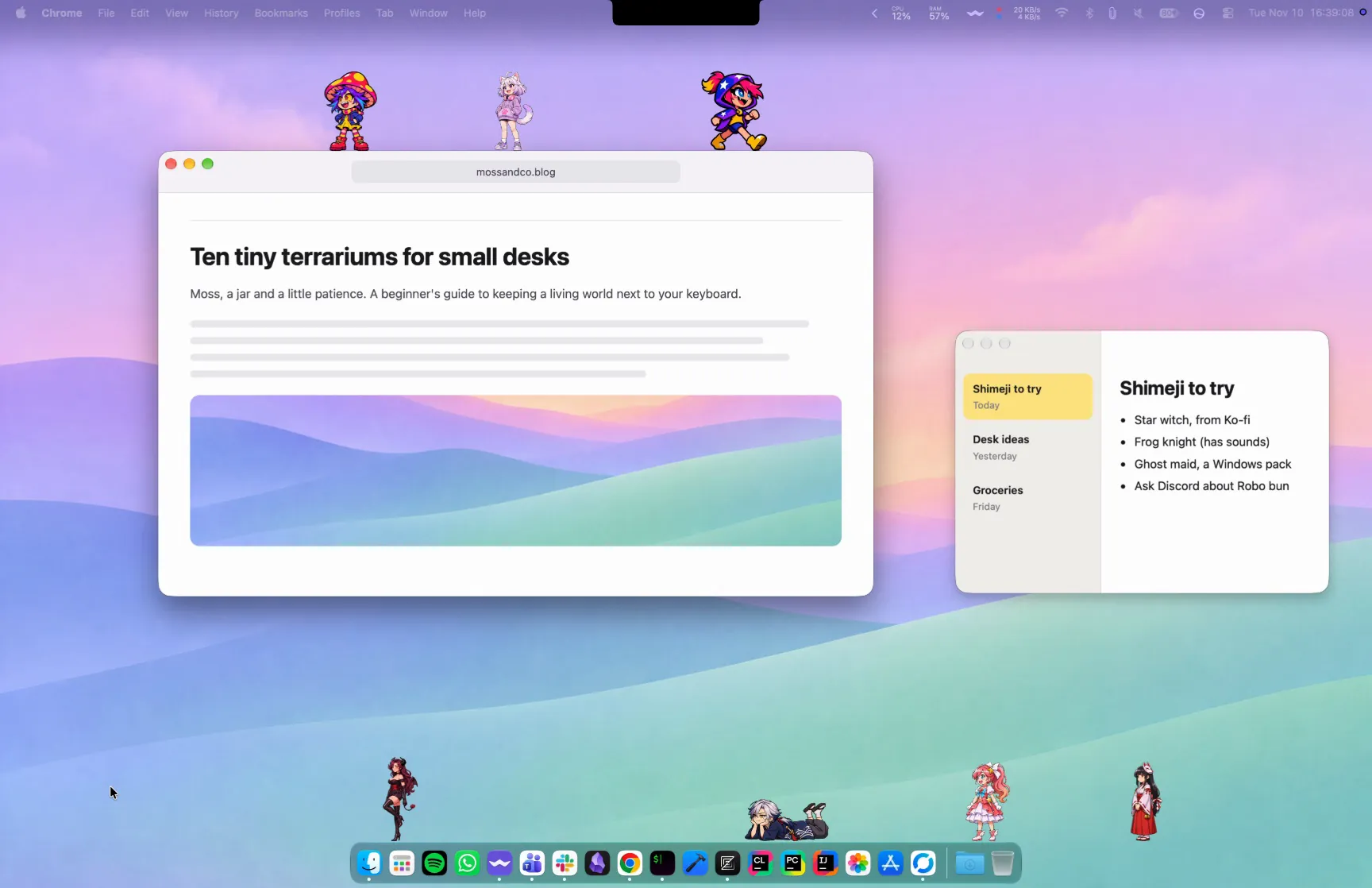
Recorded in the app with Pro: three characters on top of a browser window, four on the Dock, and a note listing packs to try. Apart from any that come with the app, each of them is a pack with its own folder in that hidden Application Support folder.
The free plan puts one character type on the screen at a time, up to 3 copies, on macOS 14 Sonoma or later with Apple silicon or Intel. Pro is a single $5.99 payment covering up to 3 Macs (checked 2026-11-24 on shimejiko.app). Get Shimejiko, or read whether Shimeji is safe before you import packs from the web.
Questions
Why doesn't Shift-Command-Period show hidden files?
Mac Install Guide's checklist: click inside the Finder window, the desktop or the dialog first, so it's the active one; use the period key between the comma and the slash, not the one on a numeric keypad; and check whether the folder has hidden items at all with ls -a, which shows only . and .. when it has none. If you turned on AppleShowAllFiles earlier, the keys may work the other way round, as OS X Daily noted for dialogs in 2011.
How do you hide a file on a Mac?
Not by renaming it in the Finder: Apple's rename page says a name can't start with a period. In Terminal, type chflags hidden and a space, drag the file into the window to fill in its path, as Apple's Terminal guide describes, and press Return. chflags nohidden with the same path shows it again. It isn't protection: anyone who presses Shift-Command-Period sees it.
Is it safe to show hidden files on a Mac?
Yes. Showing them changes nothing on the disk; the risk is in moving, renaming or deleting what appears. Apple's advice is to leave the folders that came with the Mac where they are.
Where is the Library folder on a Mac?
There are three. Yours is ~/Library, inside your home folder and hidden; open it with Option and Go › Library. The shared one is /Library at the top of the disk, and /System/Library belongs to macOS itself.