Shimeji on Intel and Apple silicon Macs: what actually changes?

Also in日本語한국어繁體中文简体中文EspañolDeutschPortuguês (Brasil)Français
Quick answer
Shimejiko runs on Intel and Apple silicon Macs with macOS 14 Sonoma or later. Your chip does not decide every reaction: knock and lid tricks need readable sensors, haptic purring needs a compatible trackpad, and battery reactions need a battery.
Download for MacChoosing Shimeji for an Intel or Apple silicon Mac starts with 2 different questions: can the app run, and which physical reactions can this Mac provide? Shimejiko supports both chip families on macOS 14 Sonoma or later. A missing knock reaction does not mean your Mac cannot have a desktop pet.
This guide is about choosing and checking your setup. If you need the download and import steps, start with Shimeji for Mac.
What should you check before downloading?
Open About This Mac from the Apple menu and check the macOS version first. The baseline is macOS 14 Sonoma, whether the computer has an Intel processor or an Apple chip. A Mac running an older macOS version does not meet that requirement simply because it has enough memory or a fast processor.
Next, note the exact Mac model, not only the chip. A MacBook Air and a Mac mini can both use Apple silicon while having very different hardware. The mini has no lid or internal battery. A MacBook may have both without having a readable sensor for every reaction.
You do not need a separate Intel character pack or an Apple silicon character pack. Shimejiko reads the character's images and behavior files through its native Mac engine. You do not need Java to run those packs in Shimejiko.
What stays the same on Intel and Apple silicon?
The desktop companion is the starting point on either platform: characters walk, sit and can be picked up with the pointer. Window interactions are a separate question from motion sensors. Climbing and riding windows use the app's window features, not a knock sensor. Moving or throwing windows is separate and requires Accessibility access.
An Intel Mac that meets the macOS requirement is therefore still a useful home for a Shimeji. You do not need to replace it just to put a little friend beside your work. Equally, an Apple silicon badge is not a promise that every Mac magic reaction will work.
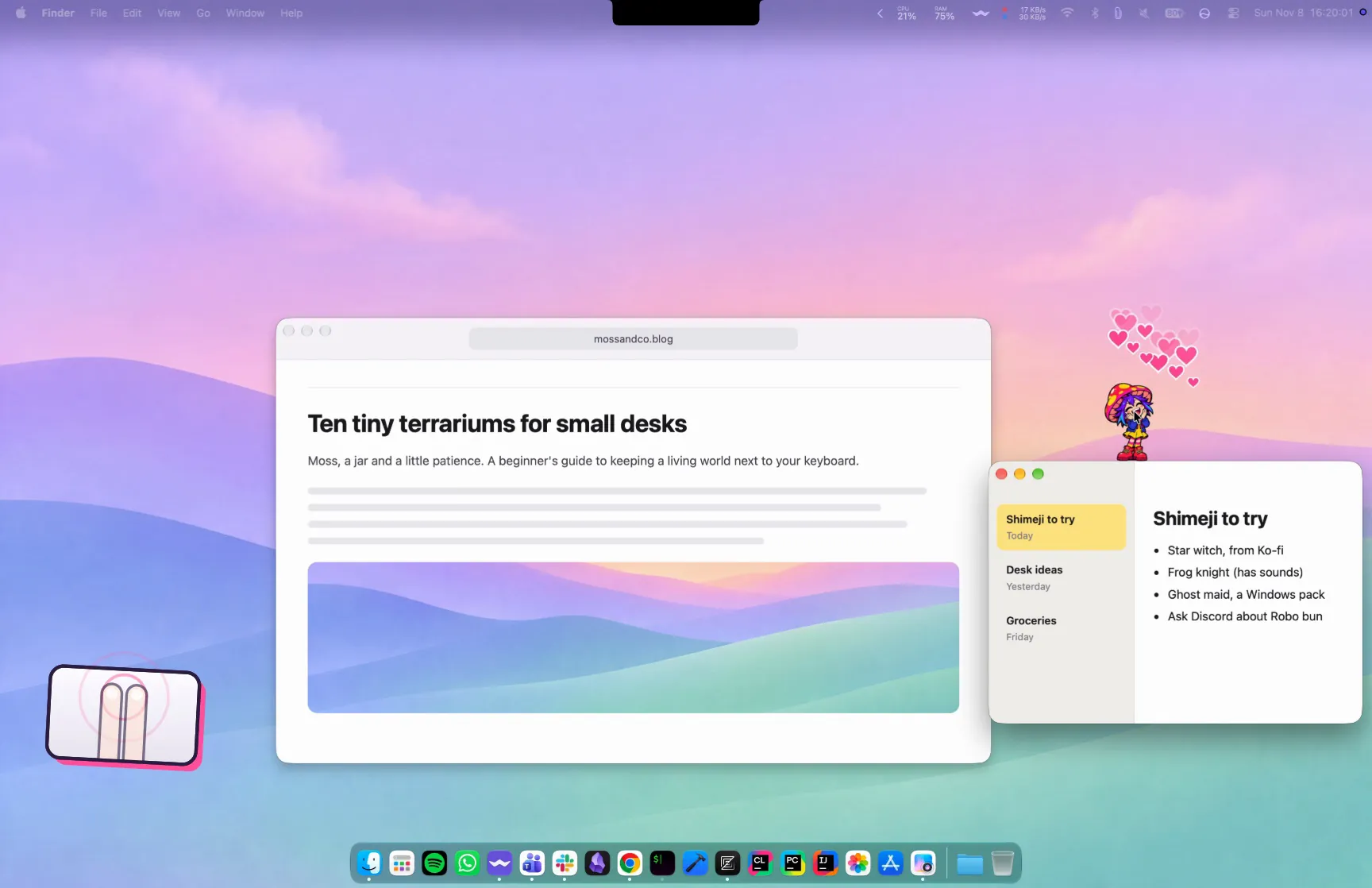
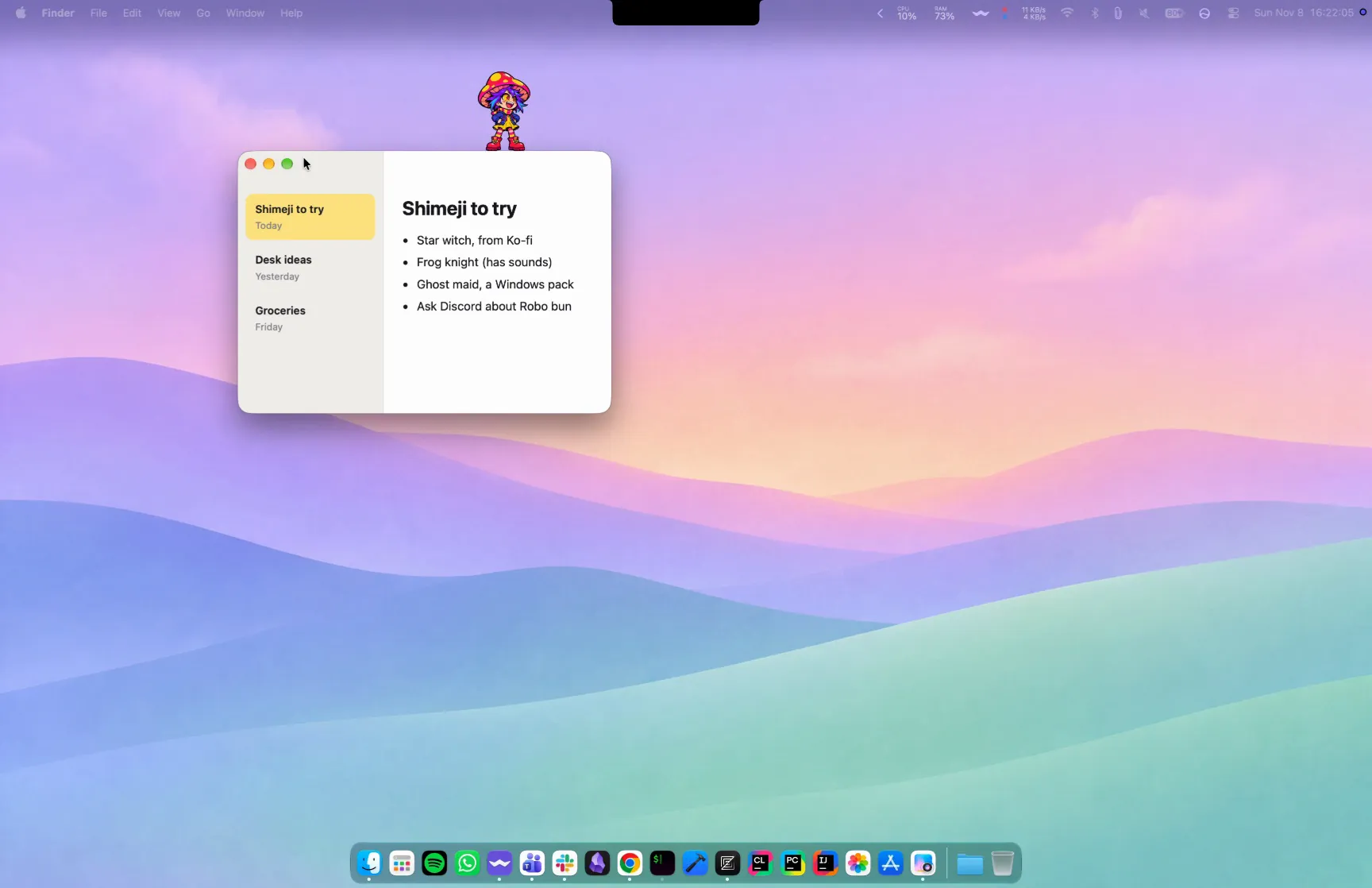
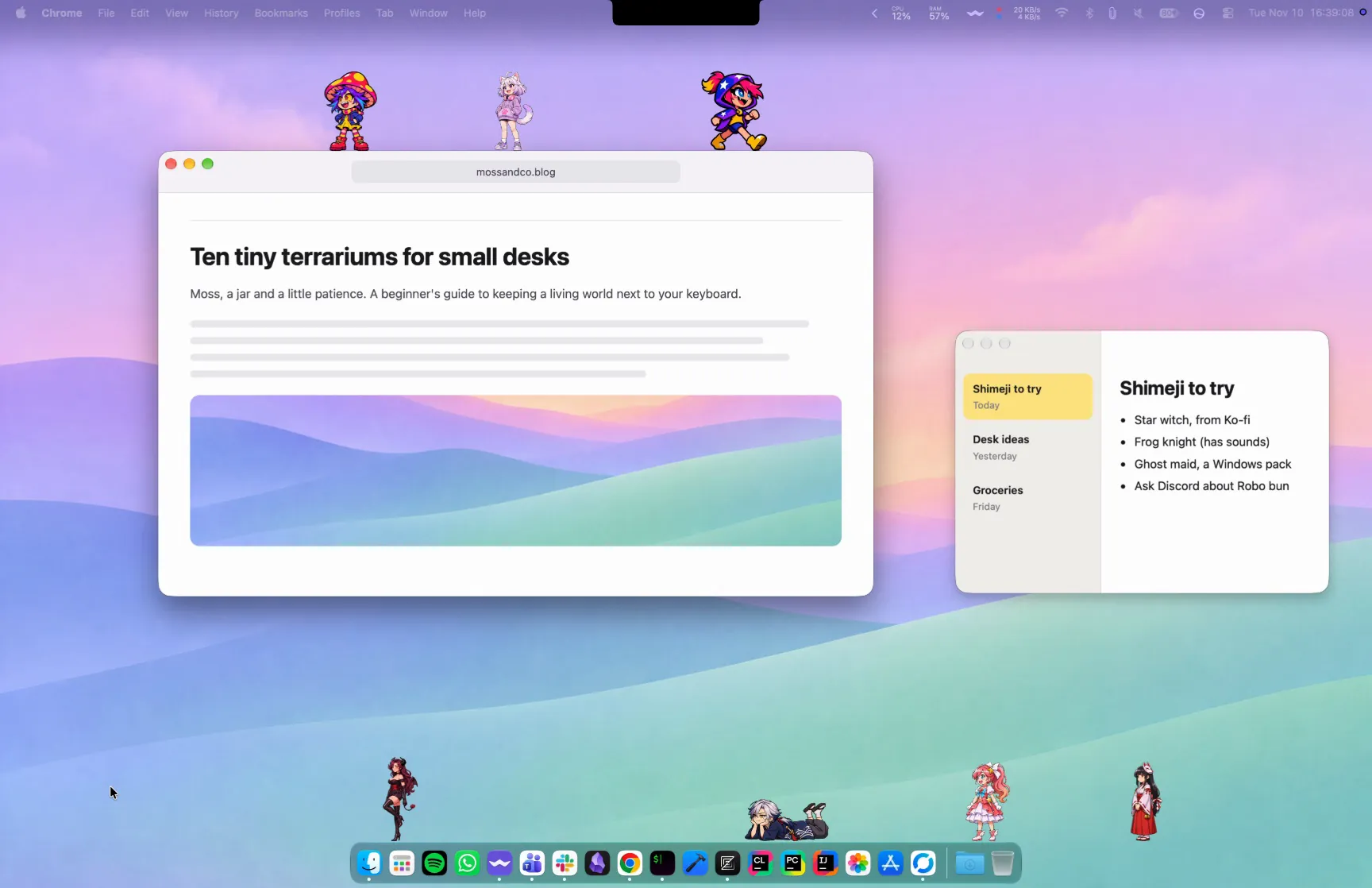
This real MacBook recording shows desktop companions with Pro. It demonstrates the experience, not a compatibility test for every Mac model.
Which Mac magic features depend on hardware?
Think in terms of the component each reaction needs:
- Knock: a motion sensor that the app can actually read. The published compatibility guide excludes Intel Macs, desktop Macs, the M1 MacBook Air, the 13-inch M1 MacBook Pro and MacBook Neo.
- Lid tilt: a readable lid angle sensor, not merely a hinged screen. The published guide lists MacBook Air from M2 and 14 and 16-inch MacBook Pro from M1 Pro and M1 Max; it excludes every 13-inch MacBook Pro.
- Purring you can feel: a Force Touch trackpad with haptic feedback enabled. That can be built in or a compatible Magic Trackpad 2 or 3. Having a trackpad is not the same as having working haptics.
- Notch perch: an actual notched display. On Macs without a notch, characters can perch on the menu bar instead.
- Dinner and sleepiness: an internal battery. Connecting a desktop Mac to mains power does not make it a battery-powered laptop.
These are separate checks. A desktop Mac with a compatible Magic Trackpad can offer haptic petting without gaining lid or battery reactions. An Intel MacBook can still have a battery and a Force Touch trackpad even though knock is unavailable.
For demonstrations of the individual reactions, see the MacBook desktop pet guide.
How do you check your own Mac rather than guess?
- Open Shimejiko's Mac magic page and inspect the status for each feature.
- Read an unavailable feature's explanation. The app distinguishes missing hardware from a sensor it cannot read. Purring can still offer sound and hearts without haptic feedback.
- If the page asks for access, follow the explanation for that feature. Granting permission cannot add a sensor your Mac does not have.
- Test with Shimejiko herself first. On the free plan she can use knock, lid and petting where the hardware supports them. Pro extends those reactions to other characters.
The app checks real hardware, including whether a motion sensor supplies a sample and whether the lid sensor answers a read. That makes the status on your own machine more useful than guessing from its purchase year.
Keep the test gentle. If knock is unsupported, hitting the case harder will not help. If haptics are unavailable, check the connected trackpad and its haptic setting before assuming the character pack is broken.
Do you need a newer Mac or Pro?
Start with the Mac you already own, if it meets the macOS requirement. Pro changes which characters can join in supported reactions; it does not install missing hardware. A new pack does not add sensors either.
Download Shimejiko for free and try the illustrated Shimejiko on your own desktop. Her 8-bit twin also comes with the app. Once you know which parts of the experience you enjoy, browse the Shop for another companion.
What else do Mac owners ask?
Does an Intel Mac need different Shimeji packs?
No. Choose a compatible Shimeji pack for its art and behavior, not for the Mac's processor. Both supported chip families use Shimejiko's Mac engine.
Does every Apple silicon Mac support knock and lid tilt?
No. Model and readable sensors matter. Even within MacBooks, knock and lid compatibility differ, so check the Mac magic page.
Will Pro unlock a reaction marked unavailable?
Not when the limitation is hardware. Pro extends supported knock, lid and petting reactions to other characters, but it cannot add a motion sensor, lid sensor, battery or haptic trackpad.